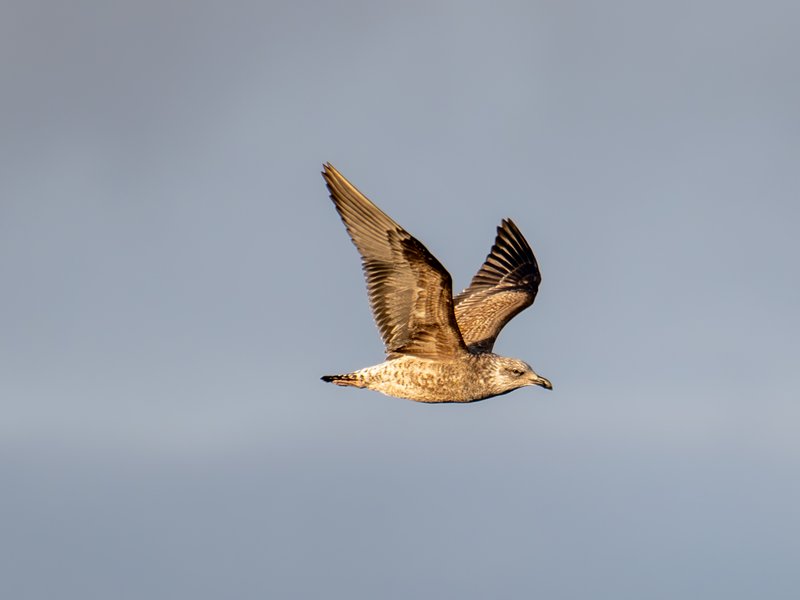
Kelp Gull
Kelp Gull
55-60 cm; span 1.28-1.4 m. Bill slimmer than Pacific, red spot on lower tip only; legs green-grey to yellowish. Wing has wider white trailing edge; single white 'window' in wingtip; white tips to primaries; tail all-white. N.B. Birds in sub-adult plumage may temporarily have clear-cut black tail band, confusable with Pacific Gull: check other features. Juvenile: bill and eye black; brown plumage streaked paler on head/neck; wing feathers have angled pale edges, forming small diamond patterns; in flight, wide pale trailing edge; tail brown, obscurely banded darker; broad black terminal band. Immature: bill pale creamy-horn, with dark tip, then yellowish; eye yellowish white; head/body brownish, then smutty white; wings brownish black without white windows; tail all white, or dark terminal band. Gregarious: noisy, aggressive; follows fishing boats; drops molluscs on rocks.
- Other name
- Dominican Gull; Southern Black-backed Gull.
- Similar Species
- Pacific Gull, Lesser Black-backed Gull.
- Voice
- yelping or laughing 'yo-yo-yo-yo-yo-yo-yo', heard in nearly every film with coastal/marine scenes.
- Habitat
- coasts, bays, beaches, reefs, islands.
- Breeding
- Sept.-Dec., in pairs, loose colonies, on islands.
- Nest
- bulky cup of plant stems, grasses, seaweed; on ground, near rock, tussock.
- Eggs
- 2-3; drab grey-green, blotched, speckled dark brown, dark grey.
- Range & Status
- occurs locally and patchily in coastal se. and s. Aust. and Tas.; small breeding colonies Moon I., Five Is., and Sydney-Port Kembla region (NSW); Seal Rocks and Lady Julia Percy I. (Vic.); s. WA w. to Esperance. Larger colonies (c. 200 pairs) on islands s. of Hobart (Tas.). Dispersive. Casual Cairns, Townsville (Q); Jurien Bay (WA). Also NZ, s. S. America, S. Africa, many sub-Antarctic islands.
- Distribution key to races
- 1. Larus dominicanus dominicanus