Magpie-lark
Magpie-lark
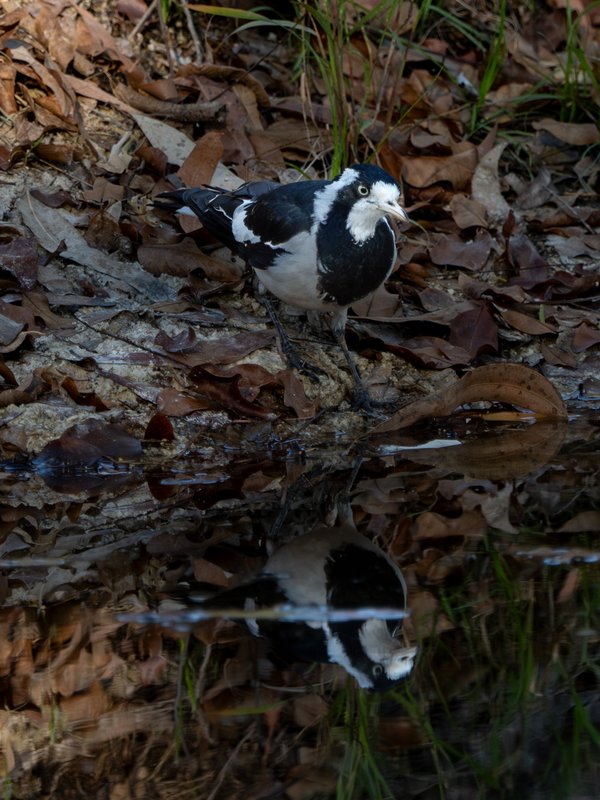
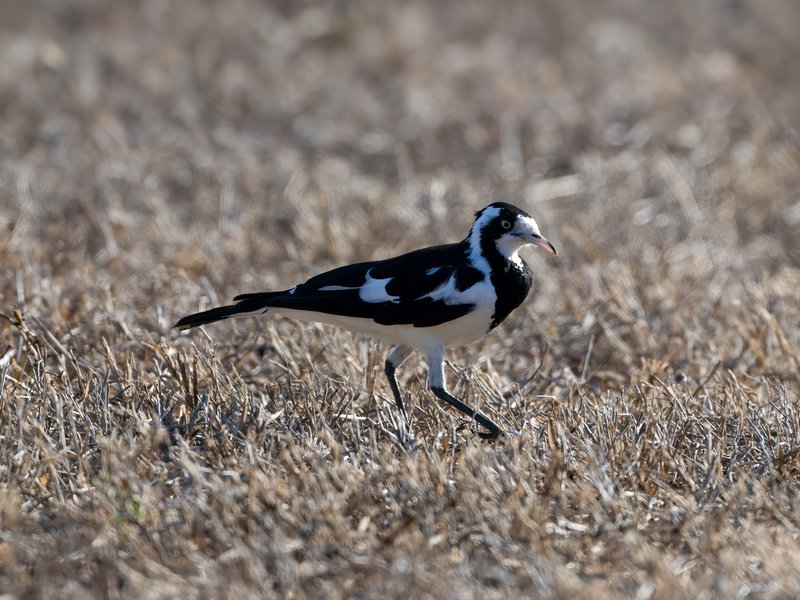
26-30 cm. Now regarded as a giant monarch flycatcher, but because often seen skirmishing with Australian Magpie, and linked by association of names, they are grouped together here. Male: bill white; eye yellowish white; legs black; head/breast-patch black; prominent white eyebrow and broad white panel down side of neck below eye. Female: forehead/throat white; broad black band from crown down through eye to black breastband. Immature: bill and eye dark; pattern differs - brownish black of forehead/crown/nape extends in band down through eye to black breastband, leaving white throat. Pairs, family parties, loose autumn-winter flocks. Noisy, demonstrative, particularly before roosting. Males may hold territories throughout year, frequently skirmishing with neighbouring pairs, magpies, raptors. Forages on ground, walks with back-and-forward head movement; wades. In flight, rounded wings make lapping strokes; flutters, lifts, dodges lightly. Calls on wing while flying with exaggerated, catchy wingbeats. Note white tail with broad subterminal black band pointing up centre. Birds in n. Aust. smaller.
- Other name
- Little or Murray Magpie; Mudlark; Peewee; Peewit.
- Similar Species
- White-winged Triller: smaller; bill/head black; underparts white. Pied Butcherbird: robust, hooked bill; hood black; longish tail black with large white corners.
- Voice
- mated pairs duet; one bird utters loud, metallic 'knee-deep', immediately answered antiphonally by the other, 'tee-o-wee', 'pee-o-wit'; with rhythmically opening wings, spread tails. Liquid, mellow 'cloop, cloop, cloop' or 'clue-weet, clue-weet'. Alarm-call: brassy, strident, emphatic 'tee! tee! tee!'.
- Habitat
- virtually anywhere there are trees and mud for nest-building; trees by rivers/wetlands; widespread in urban areas; absent from dense forests, waterless deserts.
- Breeding
- Aug.-Nov.; almost any month after rain in arid and n. Aust.
- Nest
- frequently near that of Willie Wagtail and/or White-winged Triller; bowl-shaped, of mud, bound with grass; lined with hair, grass, feathers; on horizontal branch 6-15 m high, often over water or on artificial structure.
- Eggs
- 3-5; white/pale pink; spotted, blotched reddish, purplish brown, violet.
- Range & Status
- Aust. and coastal islands, e.g. Kangaroo I. (SA), Lord Howe I.; casual Bass Strait islands; vagrant n. and e. Tas. Common, often abundant. Sedentary, nomadic; winter migration to Top End (NT), C. York Pen. (Q). Also s. PNG; Timor.
- Distribution key to races
- 1. Grallina cyanoleuca neglecta 2. Grallina cyanoleuca cyanoleuca