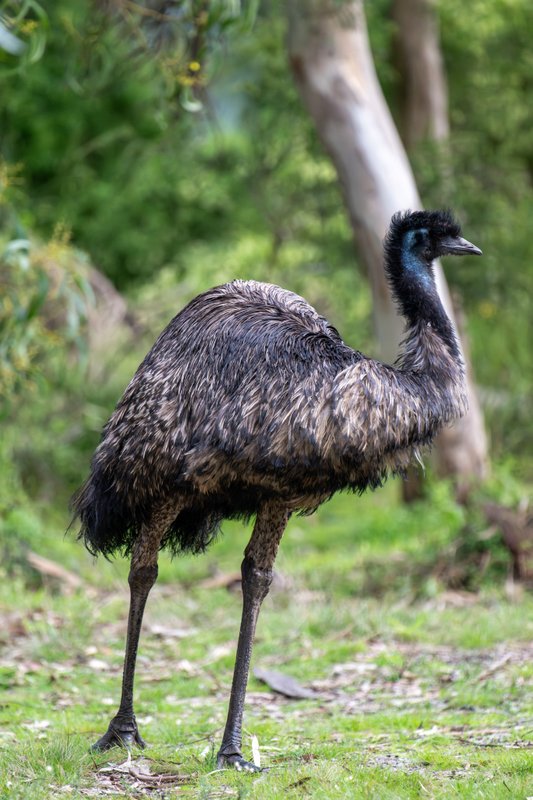
Emu
Emu
1.5-2 m. Female slightly larger. Our largest native bird: plumage loose, each feather divided, pale grey-brown to almost black; bare skin of head and neck whitish to blue, darkest in female in breeding condition; eye yellow, grey-brown or reddish; legs dark grey. Birds of se. race novaehollandiae have collar of pale, creamy feathers when breeding. Races in w. Aust. darker; in n., paler. Juvenile: to 2-3 months, greyish to buff with spotted crown, bold black or brown body stripes. Immature: head and neck feathered blackish; body plumage darker and patterned; matures at 18-24 months. Pairs to loose feeding companies of dozens; hundreds where food plentiful. Shy but curious; runs with bouncy flounces, up to 50 km/h in short bursts; swims well.
- Similar Species
- Ostrich.
- Voice
- male: deep growling grunts; female: sequences of up to 10-12, single or double, loud thudding drummings; young: whistling peeps.
- Habitat
- plains, scrublands, open woodlands, coastal heaths, alpine pastures, semi-deserts, margins of lakes; pastoral and cereal-growing areas.
- Breeding
- April-Oct.
- Eggs
- 5-11; large, dark green, granulated; laid on scanty collection of leaves, grass, bark or sticks. Male alone broods, escorts family around a large home range for up to 18 months.
- Range & Status
- Aust. mainland, now mostly absent from closely settled parts. Common in pastoral and cropping regions; state forests, national parks. Migratory in s. WA, with coastwards movement in spring, after breeding. Tas. race diemenensis, as well as King I. Emu, D. ater, and Kangaroo I. Emu, D. baudinianus, became extinct in 19th century as result of European settlement.