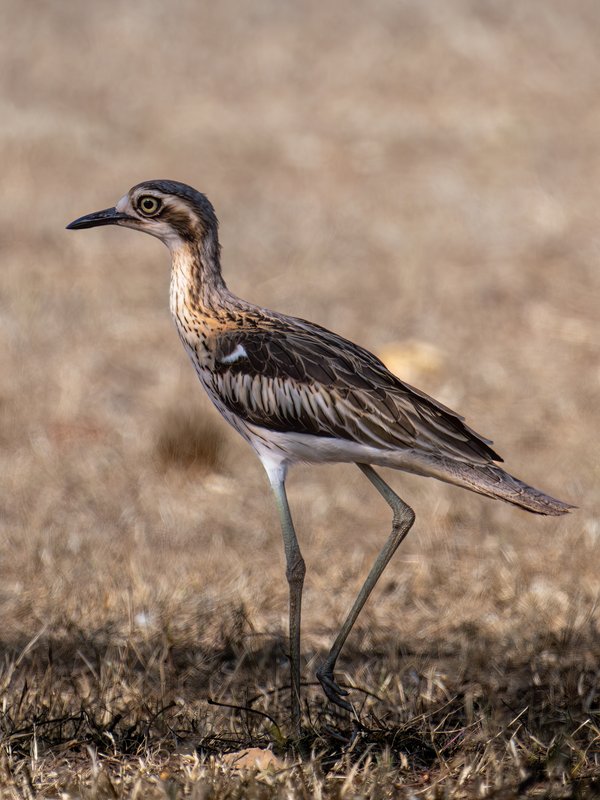
Bush Stone-curlew
Bush Stone-curlew
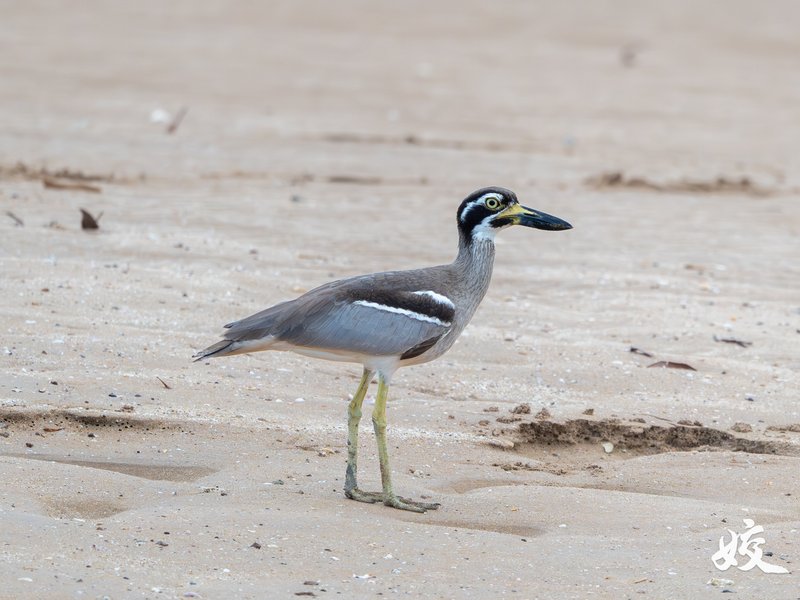
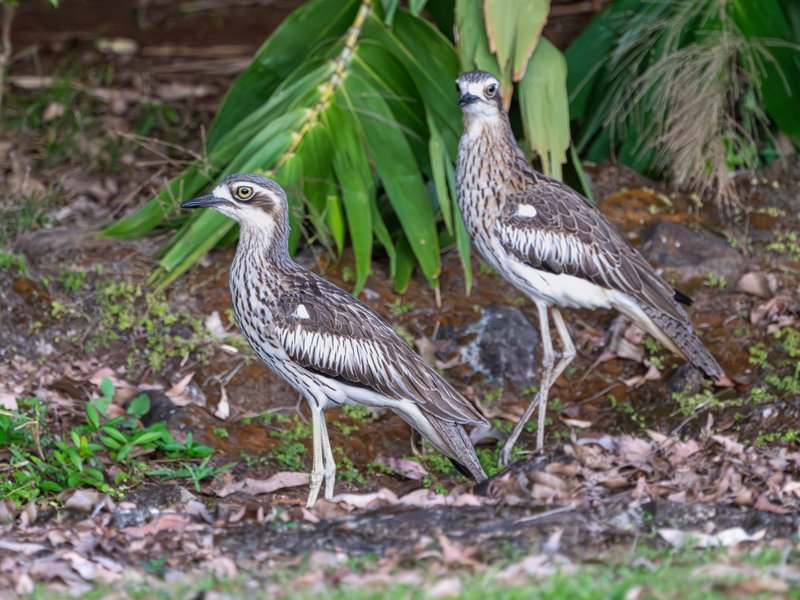
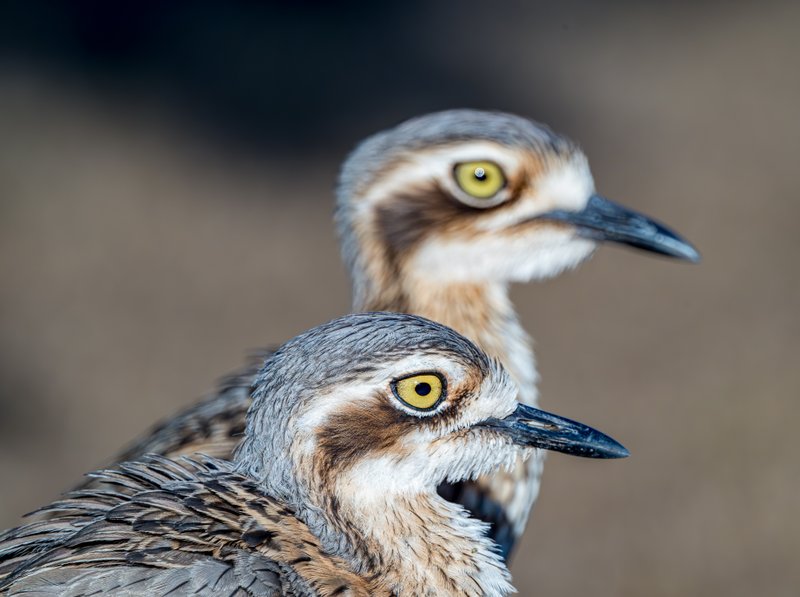
55-59 cm; span 80 cm-1.05 m. Unusual, bush-dwelling wader, more often heard than seen. Grey-brown above (washed pale rufous in n. Aust.), buff-white below, strongly streaked darker; dark mark along wing over a broader pale zone. Bill blackish, forehead whitish; broad white eyebrow over thick black line from below eye down neck; eye large, yellow. Pairs, groups to loose flocks. Shy, watchful: moves weirdly, slowly, often with head lowered. 'Freezes' stick-like, lies flat with neck extended, walks deliberately away or runs furtively. Flies with quick, stiff beats of long, bowed wings, revealing prominent white patch across black primaries. Active at night, often on country roads; wingpatches luminous in headlights. Tame near habitation: golf courses, resort islands.
- Other name
- Bush Thick-knee; Southern Stone-curlew; Weeloo; Willaroo.
- Similar Species
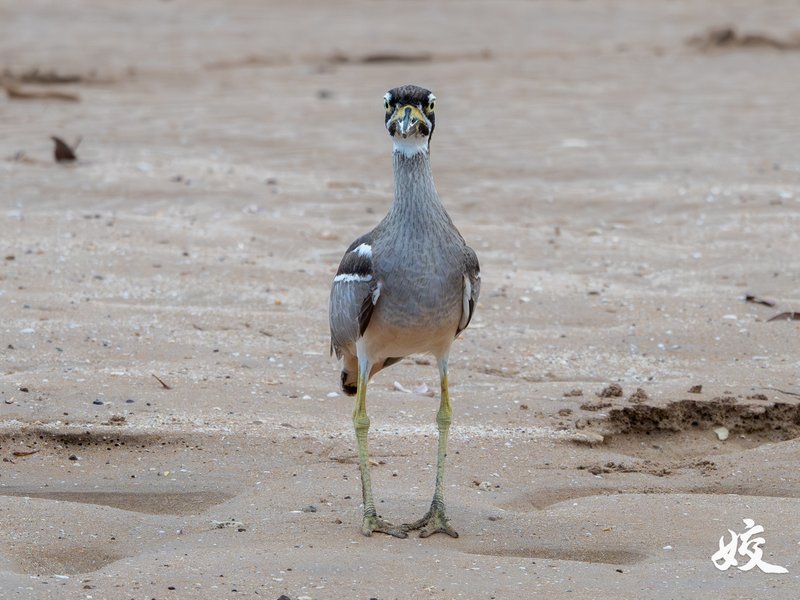
- Beach Stone-curlew.
- Voice
- usually at night: a far-carrying, eerie whistling call (or chorus) that starts low and quietly - a drawn-out 'wee-eeer', repeated up to 5 times; rises, becomes a high-pitched, drawn-out 'keeleeoo', quickens, breaks, descends, often ends in a chorus of 'wee-wiff; wee-wiff; wee-wiff', by several birds. Other groups respond. Screeches in flight.
- Habitat
- open woodland, dry watercourses with fallen branches, leaf litter, sparse grass; sandplains with spinifex and mallee; coastal scrub, mangrove fringes, golf courses, rail-reserves; timber remnants on roadsides; orchards, plantations; suburbs, towns, cities in Q; resort islands.
- Breeding
- Aug.-Jan.; earlier in n. Aust.
- Eggs
- 2; on bare ground; stone-coloured, blotched dark brown, grey.
- Range & Status
- e., se., n., coastal WA, many coastal islands; vagrant Tas. Absent from s. inland and Nullarbor region. Rare to wholly extinct in settled parts of coastal se. Aust. More abundant in subtropics (incl. Brisbane suburbs) and across n. Aust. Sedentary, locally dispersive; Near-Threatened in s. Aust. Also s. PNG.