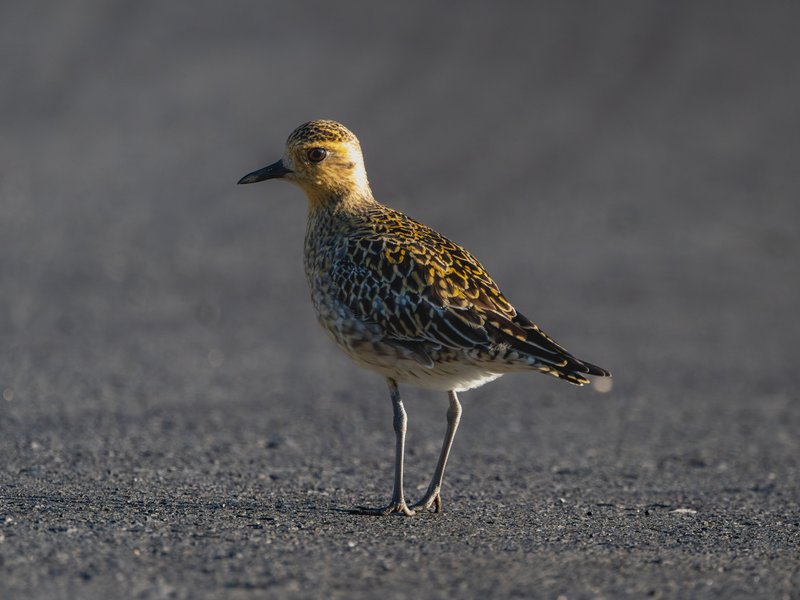
Pacific Golden Plover
Pacific Golden Plover
23-26 cm; span 60-72 cm. Smallest and most delicately built golden plover, but stands more upright, on proportionately longer legs than American or Eurasian Golden Plovers; wingtips extend just beyond tail tip.Non-breeding: pale buff forehead and face with distinct whitish to yellow-buff eyebrow; ear-coverts and upperparts brownish; yellow-buff spanglings on brown plumage of crown, back, wings and tail; breast buff-white with/without gold or white spangles; belly and undertail-coverts whitish. Juvenile: like Non-breeding adult; eyebrow more yellowish buff; crown and upperparts streaked and mottled brown, and plentifully spangled yellow; breast buff, mottled brown; flanks lightly barred brownish; underparts whitish. Breeding Plumage: face and breast black with narrow white border extending down flanks; belly and undertail-coverts white, or white, blotched black. Newly-arrived and soon-to-depart birds in moult are often patchy black below. Singles, small parties, occasional large open companies. In flight (Non-breeding), dusky grey-brown underwing; toes extend beyond tail tip. The brown, gold-speckled upperparts show indistinct pale wingbar and white shafts on primaries.
- Other name
- Eastern or Lesser Golden Plover.
- Similar Species
- American and Eurasian Golden Plovers. Grey Plover, juv. and Non-breeding. Oriental Plover: plainer, no spangling or wingbar; eyebrow and legs longer; note habitat.
- Voice
- a musical 'too-weet'; whistling 'tlooi'; rough scratchy 'kree kree kree'.
- Habitat
- estuaries, mudflats, saltmarshes, mangroves; rocky reefs and stranded seaweed on ocean shores; margins of shallow open inland swamps; sewage ponds, short-grass paddocks, sports-grounds, airfields, ploughed land.
- Range & Status
- breeds ne. Siberia and w. Alaska; regular common widespread summer migrant (Aug.-April) to PNG, Aust. and islands, incl. Norfolk and Lord Howe Is; also NZ. Mostly coastal, but many inland records; some overwinter coastally, especially in Q.