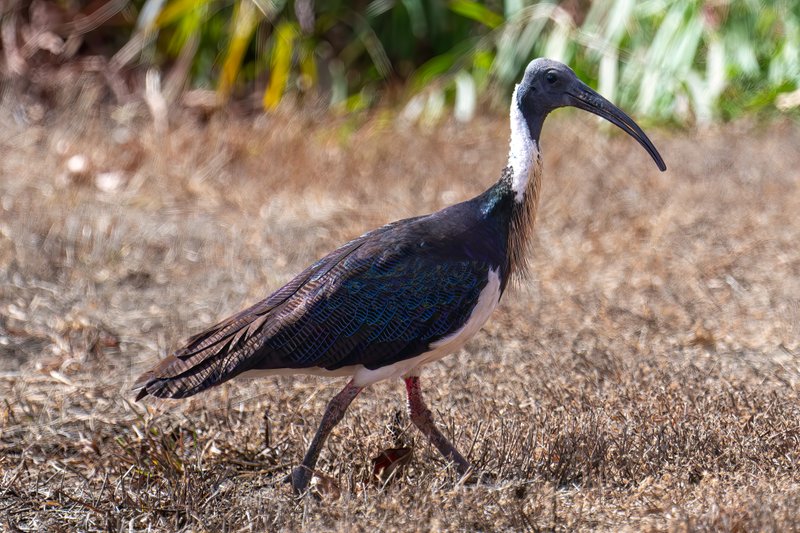
Straw-necked Ibis
Threskiornis spinicollis· 鹮科(1 photos)
Straw-necked Ibis
58-76 cm; span 1-1.2 m. Iridescent black upperparts and sides of breast contrast with white 'collar', underparts and tail. Note strawlike tuft of breast plumes. Female: bill shorter; black breastband. Immature: bill shorter and straighter; head closely feathered black; neck feathered white. Loose flocks walk in 'fronts' across grasslands or feed in shallow wetlands. Flocks wheel high, mostly black wings contrasting with snow-white wing linings, underparts and tail. Flies in Vs or long, undulating lines. Settles in dead trees by day; roosts in heads of leafy trees in woodlands and forests.
- Voice
- hoarse coughs, grunts.
- Habitat
- grasslands, sometimes far from water; freshwater wetlands, flooded areas, irrigated pastures, crops, playing fields, airfields, sewage ponds, croplands; tidal mudflats or saltmarsh (seldom).
- Breeding
- Sept.-Nov. in se. Aust.
- Nest
- shallow cup of sticks, reeds, over water in colony in trampled cumbungi, lignum, rushes, reeds, paperbarks; on ground on islands; some colonies of many 1000s.
- Eggs
- 4-5; white, dirty.
- Range & Status
- e., n. Aust. and WA; breeds widely, but largest numbers in Murrumbidgee-Murray Valley region (NSW), s. Vic. and se. SA; nonbreeding visitor Tas. Widespread movement to n. Aust. in winter; uncommon to absent in arid regions. Part-migratory; dispersive; nomadic; movements influenced by rainfall. Vagrant Lord Howe and Norfolk Is. Winter migrant to Indonesia and PNG.