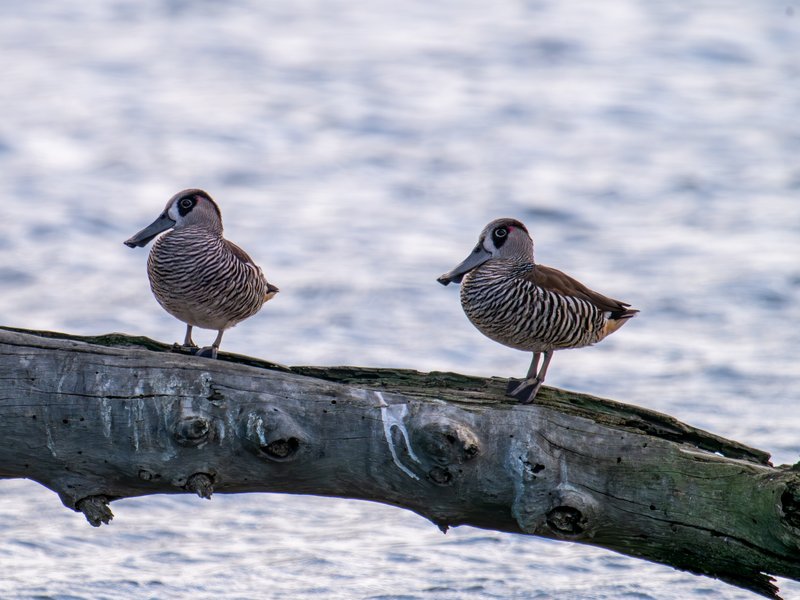
Pink-eared Duck
Pink-eared Duck
THE SOUTH EAST The far south-east of South Australia encompasses one of the more fertile and wetter regions of the state. Much of its diverse vegetation has made way for agriculture, and the remnant patches of forest and woodland, as well as wetlands, are increasingly important for wildlife. Its diversity of habitats, which also includes extensive sandy beaches, limestone cliffs, and coastal lagoons, and the relative ease of access to sites, makes this an attractive area for birdwatching. The localized Rufous Bristlebird is found in suitable habitat along the coastal areas.
38-45 cm; span 58-72 cm. Poorly named small duck with huge, square-tipped grey bill and strongly brown-barred flanks. Pale brown with darker upperparts, white forehead and face with clown-like dark brown patch over eye; pink 'ear spot' almost invisible; note white flank mark, pale ochre 'stern'. In flight, note high-held head, huge down-held bill; flying away, note pale trailing edge of wings; white rump and tail tip form white double crescent. Small to very large flocks in which pairs persist. Swims steadily ahead with bill submerged; dabbles in shallows. Feeds in rotating, locked pairs, head to tail, filtering disturbed organisms; rotating companies often spread far across surface of larger wetlands. Perches on branches, logs; associates with other ducks.
Localised Australian Endemics
Rufous Bristlebird
Other key Australian endemics
Blue-billed Duck, Musk Duck, Freckled Duck, Pink-eared Duck, Banded Stilt, Hooded Dotterel, Red-capped Plover, Long-billed Corella, Red-tailed Black Cockatoo (local race graptogyne), Southern Emu-wren, Beautiful Firetail.
Other regional specialties
Hoary-headed Grebe, Australasian Shoveler, Hardhead, Freckled Duck (mainly in drought years), Nankeen Night Heron, Australasian Bittern, Royal Spoonbill, Swamp Harrier, Buff-banded Rail (scarce), Lewin's Rail, Baillon's Crake, Spotless Crake, Brolga, Latham's Snipe (Oct-Mar), Red-necked Stint, Sharp-tailed Sandpiper, Double-banded Plover (Apr-Sep), Little Grassbird.
- Other name
- Wigeon; Zebra Duck.
- Similar Species
- Australasian Shoveler.
- Voice
- musical chirrup in flight and on water; also a sharp, high-pitched 'ee-jik!'.
- Habitat
- shallow, temporary waters; inland lignum swamps; flooded claypans; large, bare lakes; well-vegetated freshwater wetlands; sewage ponds, commercial saltfields; coastal mangroves and saline coastal wetlands during dry periods inland.
- Breeding
- any month, in suitable water conditions.
- Nest
- mound of down in which eggs are buried; in hollow tree or branch, stump, log, fence post; old nest of Eurasian Coot or other waterbird; usually over water.
- Eggs
- 5-8; smooth, pointed; white or creamy.
- Range & Status
- Aust.; mostly inland; rare vagrant Tas. Highly nomadic and dispersive, movements and breeding much influenced by rainfall.