Purple-backed Fairywren
Purple-backed Fairywren
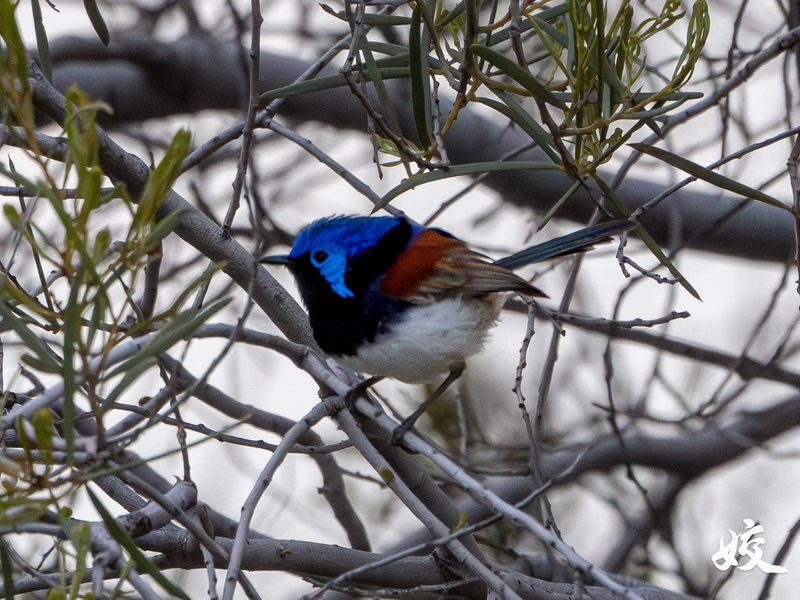
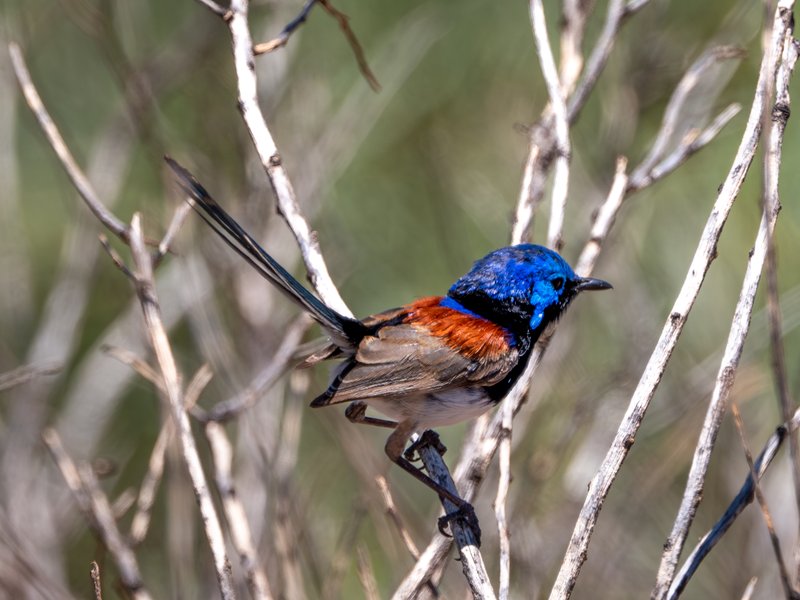
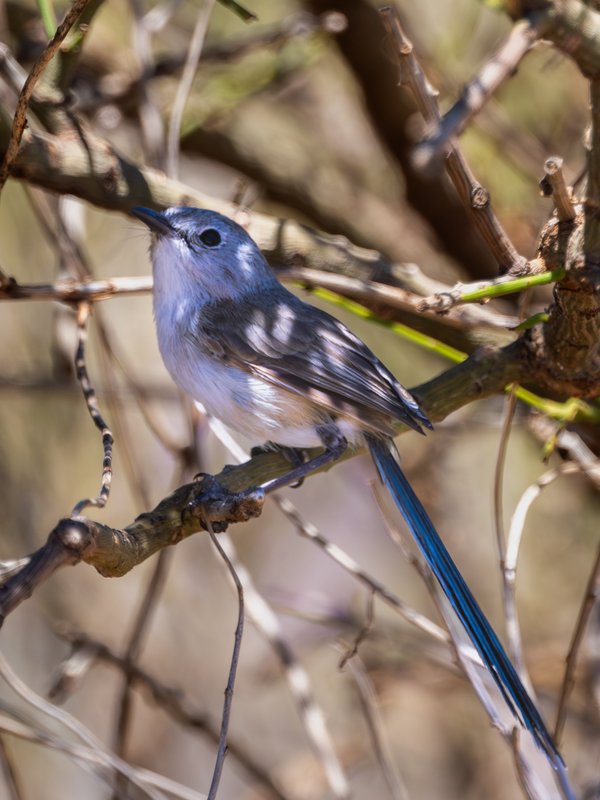
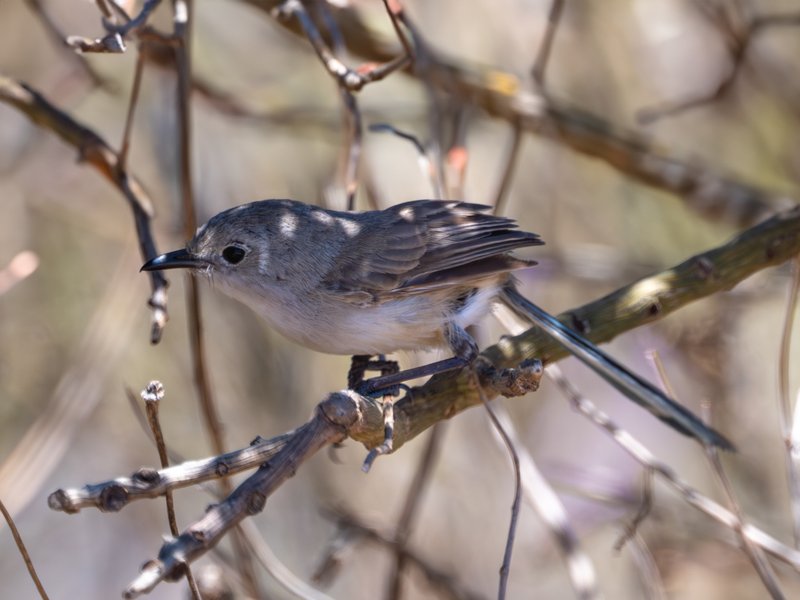
11-14.5 cm. The sole chestnut-shouldered fairy-wren across much of inland Australia. Male, Breeding: crown violet and large, pointed cheek patches bright blue; 'shoulder-patch' chestnut; back purple, extending to sides of upperbreast; lores, throat and chest jet black, cut off sharply by fawn-white underparts; tail long, blue-black, tipped white. Male, eclipse: like female but bill and lores black; tail bluer; obvious narrow off-white eye-ring; underparts whiter than female. Female: bill tan; prominent dark 'mask' formed by dark chestnut lores and eye-ring. Upperparts pale brown, incl. very long, blue-washed tail; underparts fawn-white, washed buff on flanks. In nw. Aust., two distinctive races: dulcis, of Arnhem Land escarpment (NT), male: flanks deep lavender; tail short, blue with white tips; female: lores and eye-ring white; upperparts blue-grey; tail blue, tipped white. Race rogersi, ranging w. from Arnhem Land escarpment (NT) into Kimberley region (WA): similar, but females have tan-coloured lores and eye-ring. Both dulcis and rogersi interbreed with assimilis where their ranges overlap. Pairs, parties: 'brown birds' usually predominate; coloured males may forage together, often high in shrubs, trees.
- Similar Species
- Variegated Fairywren in the e., Blue-breasted Fairy-wren in s. WA-Eyre Pen. (SA); Red-winged Fairy-wren in s. WA; Lovely Fairy-wren in ne. Q. Female 'blue wrens' lack distinctive dark-chestnut lores and eye-ring; most have shorter tails.
- Voice
- somewhat like Superb, but harder, higher-pitched.
- Habitat
- mallee, mulga, saltbush, lignum and spinifex; shrubby or rank grassy vegetation on watercourses. Races dulcis and rogersi: shrubs and spinifex in rugged sandstone hills and gorges; shrubs, grass on watercourses; pandanus, paperbarks by freshwater springs, pools.
- Breeding
- July-March.
- Nest
- domed, loosely woven; of soft grass, bark strips, plant down, spiders' web and egg-sacs; low in undergrowth or low shrub, or tall tuft of grass.
- Eggs
- 3-4 (dulcis and rogersi 2-3); white, finely speckled with reddish purple, mostly at large end.
- Range & Status
- widespread in mainland Aust. w. of Variegated Fairywren; absent from ne. Q beyond c. Georgetown-upper Burdekin R.-Townsville, from s., e. and ne. Vic., from extreme se. SA, Adelaide-Mt Lofty Ras. and Kangaroo I., from s. WA s. and w. of Geraldton-Eucla (but with long coastal extension s. from Geraldton to near Perth). Race dulcis: w. Arnhem Land (NT) from King R. w. to near South Alligator R. Race rogersi: w. fringes of Arnhem Land escarpment (NT) w. to Kimberley region (WA). Fairly common. Mostly sedentary.
- Distribution key to races
- 1. Malurus assimilis rogersi 2. Malurus assimilis dulcis 4. Malurus assimilis assimilis 5. Malurus assimilis bernieri