Rufous Bristlebird
Dasyornis broadbenti· 刺莺科(2 photos)
Rufous Bristlebird
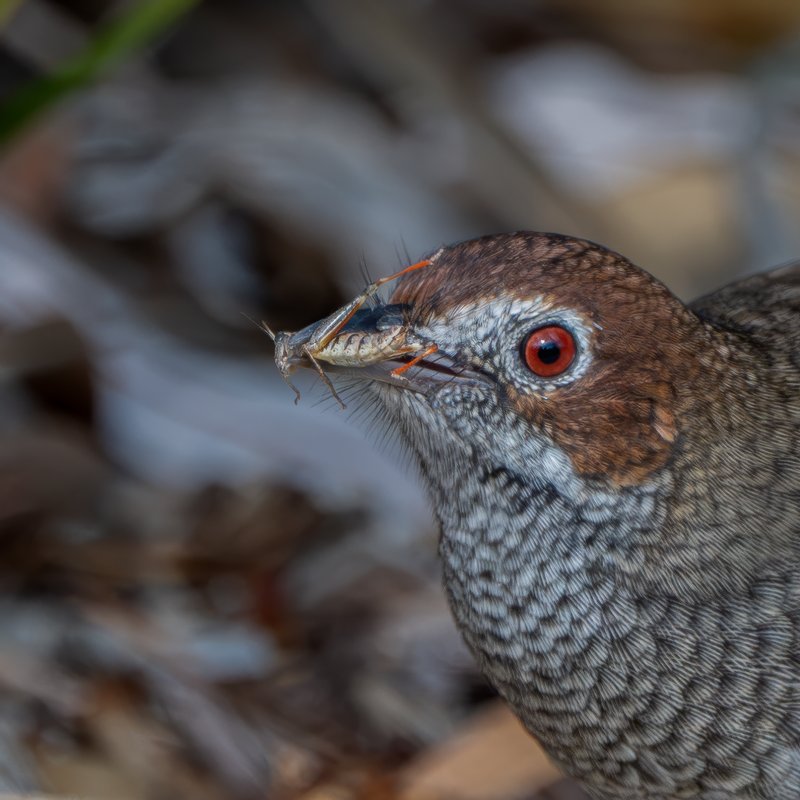
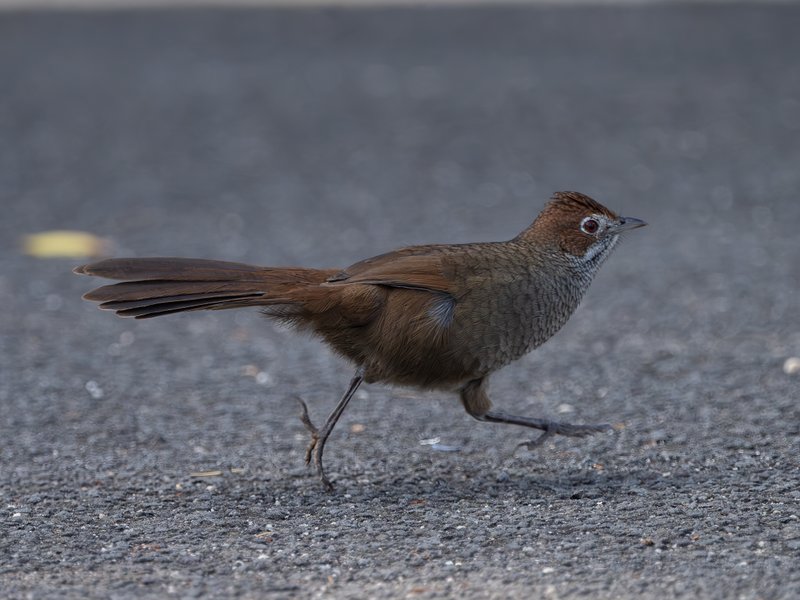
24-27 cm. Largest bristlebird: rich rufous cap and 'ear mufflers' contrast with olive-grey upperparts; wings washed rufous; underparts distinctly scalloped pale grey. Shy, elusive, inquisitive; more often heard than seen; runs swiftly; alarmed, raises, spreads longish full tail.
- Similar Species
- Eastern Bristlebird; female Common Blackbird.
- Voice
- 3 or 4 clear, penetrating, silvery notes rising in quick succession, ending with double whip-like crack; last 3 often echoed by female: 'chip, chip, chip, chewee', or with softer 'chew-a'. Variations: 'chip, chip, chip, chip-choowee' or 'chit, chit, chit, chit, chewee-wit'; short, sharp alarm call.
- Habitat
- coastal scrubs and thickets; gullies with rank growth of sword-grass, blackberries, etc.; undergrowth in gullies in temperate rainforest.
- Breeding
- Aug.-Oct.
- Nest
- largish, untidy, domed; of thin twigs; usually in small tea-tree, clump of sword-grass 0.5-2 m high.
- Eggs
- 2; whitish, heavily, uniformly freckled red and purplish.
- Range & Status
- from mouth of Murray R. (SA), e. along coast to Jan Juc (Vic.); ranges varying distances inland in suitable habitat, e.g. Cobden-Forrest (Vic.). Fairly common. Local. Sedentary. Until recent decades, w. race litoralis was found from C. Naturaliste-C. Leeuwin (far sw. WA); presumed extinct.
- Distribution key to races
- 1. Dasyornis broadbenti caryochrous 2. Dasyornis broadbenti broadbenti