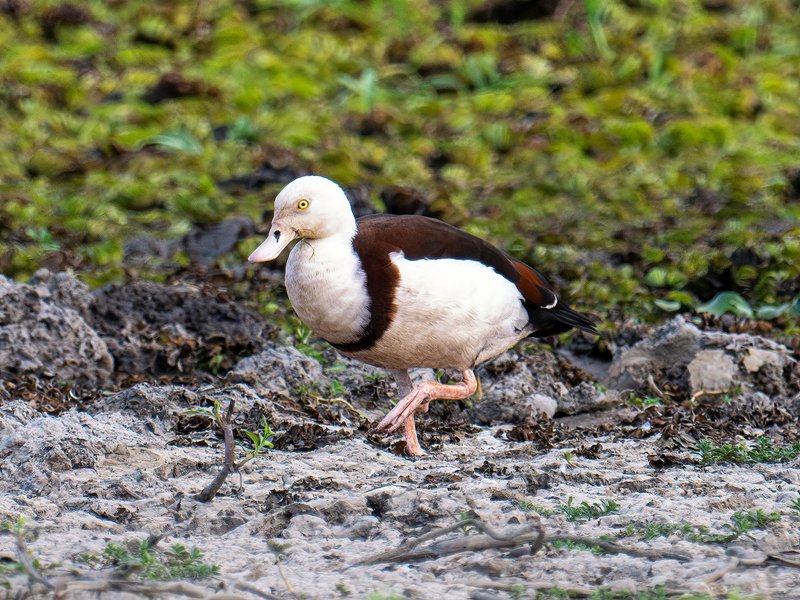
Radjah Shelduck
Radjah Shelduck
Fleurieu Peninsula This large windswept peninsula south of Adelaide is a good place to look for seabirds but also has a number of wetlands and forested conservation reserves which provide habitat for a number of significant species.
48-60 cm; span 90 cm-1 m. Conspicuous white duck with pale, flesh-coloured bill, pink legs, dark chestnut upperparts and breastband, narrower in female; white plumage sometimes rust-stained. Immature: duller; flecked grey and brown. Pairs, parties, dry-season flocks: often perches in paperbarks over water; rests conspicuously on sandbars, mudflats. Feeds ashore or on margins of wetlands; pairs or parties dabble in shallows, frequently upending; busy, active, quarrelsome; part-nocturnal. In flight, from below, white wings look dipped in ink; note breastband and dark tail. Often flies through swamp woodland below canopy.
- Other name
- Burdekin Duck; White-headed Shelduck.
- Voice
- male: hoarse whistles. Female: harsh rattling, usually in flight.
- Habitat
- in wet season, most shallow waters: fresh, salt and brackish swamps, mangrove-lined coastal creeks, shallow river margins. In dry season, concentrates on larger permanent lagoons, paperbark swamps, man-made wetlands, mangroves, tidal mudflats, estuaries.
- Breeding
- Feb.-July or later, depending on wet season.
- Nest
- in tree hollow usually in or near water.
- Eggs
- 6-12; cream, smooth.
- Range & Status
- coastal tropical n. Aust., from e. Kimberley (WA) to c. Rockhampton (Q), with possible break on Gulf coast (NT-Q); occasionally casual s. WA, s. SA, n. Vic., NSW, s. Q. (Range formerly extended into ne. NSW.) Sedentary; locally dispersive in dry season. Also Torres Strait islands, PNG, e. Indonesia.
- Distribution key to races
- 1. Radjah radjah rufitergum