Spotted Dove
Spilopelia chinensis· 鸠鸽科(2 photos)
Spotted Dove
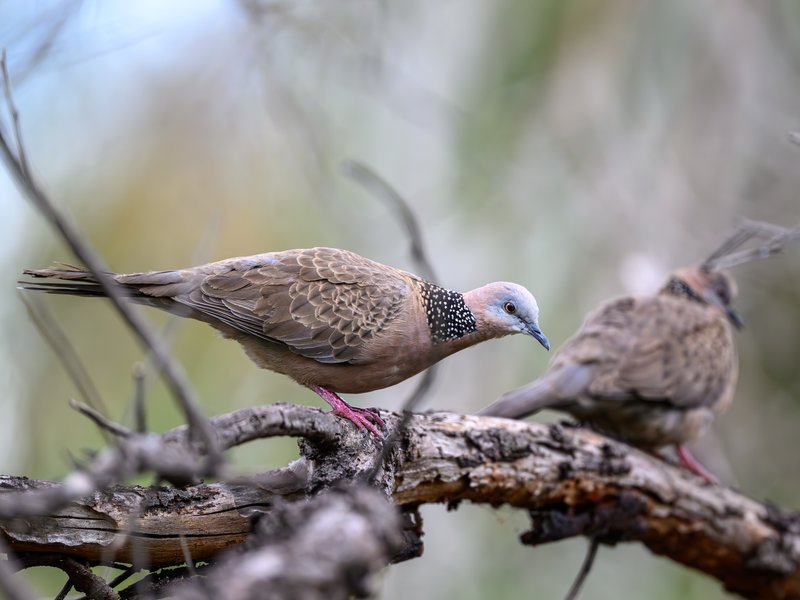
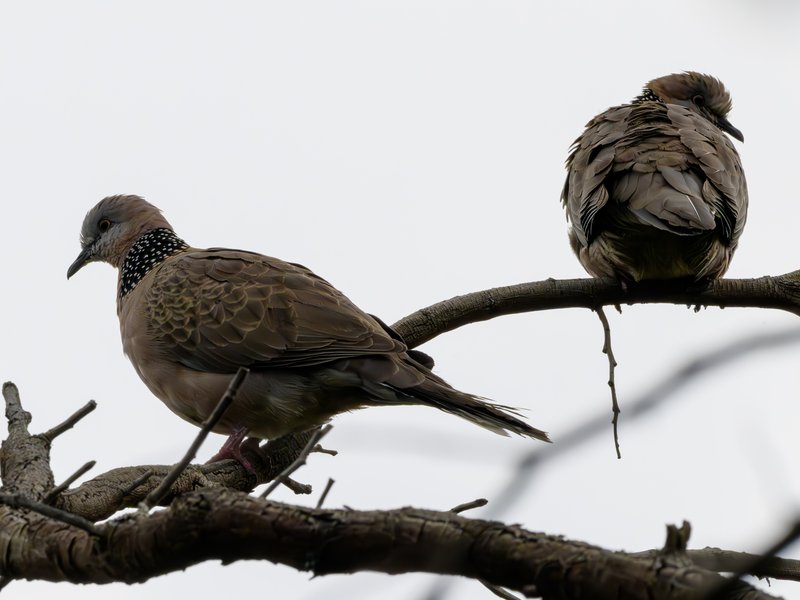
28-32 cm. Head pale grey; white-spotted black patch on hindneck; breast pinkish grey. Juvenile: plainer; no chequered patch. Singles, pairs, companies: feeds on ground, walking sedately. Flight direct: note blue-grey shoulders; tail feathers mostly black, with broad white tail corners. Displaying males clatter up at steep angle, circle down on spread wings/tail.
- Other name
- Chinese, Indian Turtle-Dove; Spotted Turtle-Dove.
- Similar Species
- Bar-shouldered Dove: blue-grey face/foreneck; barred copper nape; flies with head raised, showing coppery flight-feathers; spread brown tail shows narrow white tips to all but two central tail feathers. Laughing Turtle-Dove (WA): reddish fawn, no rear collar; black-streaked breastband.
- Voice
- mellow, rough 'coocoo, croo(oo)', or more emphatic 'coo-coo, krroo, kook!'.
- Habitat
- streets, parks, gardens, railyards, wheat silos, agricultural areas, open woodlands, tropical scrubs, secondary growth, scrubby creeks.
- Breeding
- mostly Sept.-Jan. in se. Aust.; autumn in n.
- Nest
- scanty platform of twigs, rootlets; 1-15 m in shrub, dense tree, often exotic; ledges, level surfaces in buildings.
- Eggs
- 2; white, slightly glossy.
- Range & Status
- Locally common in and near settlement in coastal e., se. Aust. and Tas. (Hobart, Launceston): from Cooktown (Q) to Adelaide and Port Lincoln (SA); also sw. WA, Perth-Pemberton; Kalgoorlie; Esperance. Sedentary; expanding. Two races, tigrina and chinensis, of Burma-Malaya and s. China, were introduced from 1860s on; now much hybridised, but tigrina persists in ne. Q, (Blakers et al, 1984); while chinensis is predominant in s. Vic.