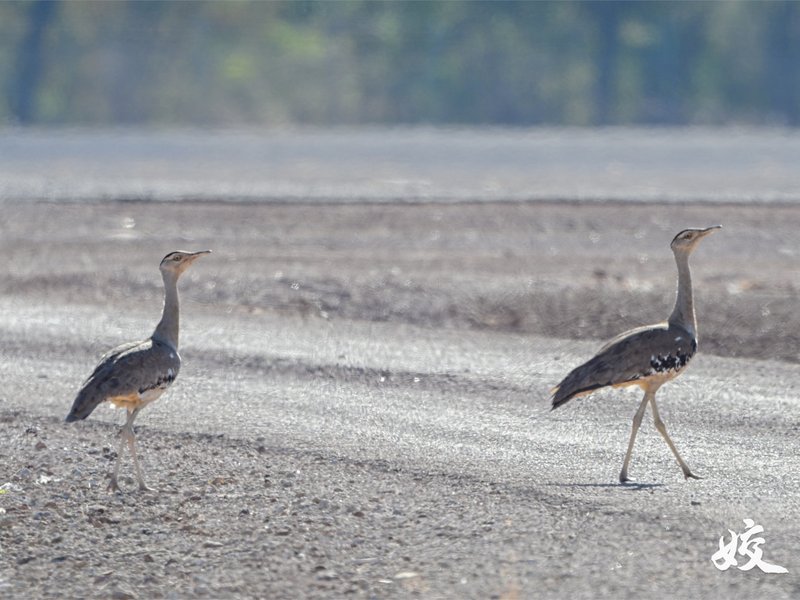
Australian Bustard
Australian Bustard
76 cm-1.5 m; span 1.6-2.1 m. Male larger. Lordly, upstanding large bird of open country. Male: crown black; face, neck and breast grey-white, with bold black breastband; bend of wing patterned black and white. Female: smaller; narrow, browner crown; neck/breast greyer, no breastband. Singles, pairs, groups: in n. Aust., companies of dozens (occasionally hundreds) where grasshoppers, crickets, house mice abundant. Moves in stately walk, with bill aloofly raised. 'Taxies' into wind; flight powerful, large body sags, slow-beating broad wings and trailing legs distinctive. Rests unseen in tall grass or scrub in heat of day; moves out to feed at evening. Male display: conspicuous; extends expanded, white-plumaged breast sac to ground, fans tail forward over back; 'marks time' so that pendulous breast sac swings and twists conspicuously. Points bill skywards, balloons throat, roars like a distant lion.
- Other name
- Plains or Wild Turkey.
- Voice
- croaks while feeding; hoarse bark in alarm.
- Habitat
- grasslands, spinifex, open scrublands, grassy woodlands, sandhills, pastoral lands, burned ground; occasionally crops, airfields.
- Breeding
- Aug.-Nov., s. Aust.; all months, n. Aust.
- Eggs
- 1-3; buff to green-buff; on open bare ground; by bush, stones, tussock.
- Range & Status
- mainland Aust.; once widespread: still common away from settlement in parts of e. inland, inland, n. Aust. and WA. Now mostly extinct in settled districts of s., se. Aust. and sw. WA but casual wanderers still occur. Small, isolated population in Big Desert (Vic.). Nomadic, dispersive, in response to rainfall; regular movement s. in summer; to n. coastal Aust. in winter. Also s. PNG.