Varied Sittella
Varied Sittella
11-12.5 cm. A species of five (or six) distinctive geographic races around the continent, hybridising freely where ranges overlap (see map).
1. Nominate race chrysoptera, 'Orange-winged Sittella' (se. Aust.)
Bill longer in male than female; yellowish at base, with long, dark tip; legs/feet orange-yellow, robust; head grey or blackish; throat white (male); blackish grey (female). Back paler grey-brown with broad dark streaks; rump whitish; tail short, black with white tips; flight feathers black with broad, pale orange band, conspicuous in flight; underparts white, lightly streaked darker in Vic., streaking increasing through n. NSW-inland s. Q. Immature: paler; wing coverts tipped buff; underparts whitish. In flight, wings seem too large for bird; broad, pale orange wing band, white rump and white tail tips, conspicuous. Highly social: breeding groups of 5-7 in spring-summer (or autumn in n.), larger winter companies. Groups forage together, flying into heads of trees, typically working down branches and trunk with constant rocking-horse motion, probing and levering bark flakes with longish, slightly upturned bills, maintaining contact with constant chitterings, before flying on to next tree. When breeding, one female appears to lay, but all members of group feed the young. Roost comunally.
2. Race leucocephala, 'White-headed Sittella'
Head/neck white in both sexes; wing band orange; upperparts/flanks streaked dark grey. Immature: head mostly grey.
3. Race striata, 'Striated Sittella'
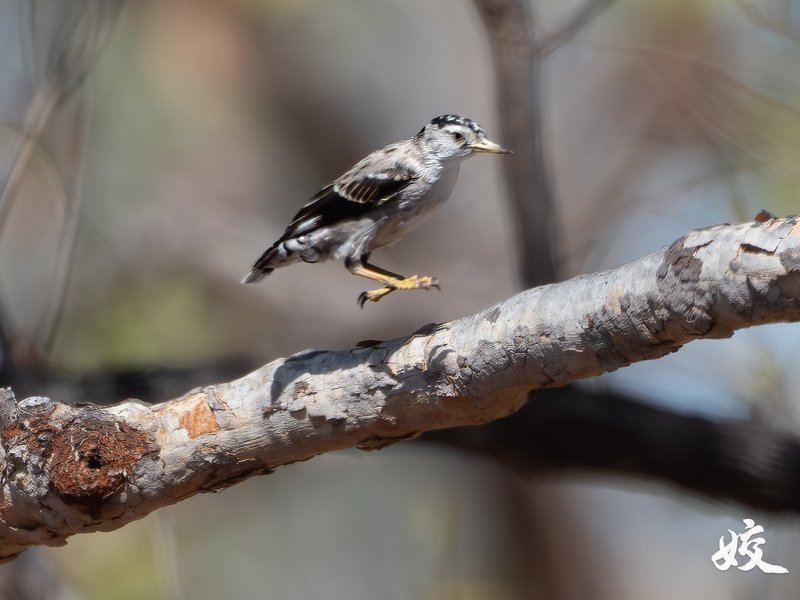
Darkest-headed, most streaked sittella. Male: crown black. Female: head/throat and sometimes upperbreast black. Both sexes grey-white above, streaked brownish black; whitish underparts finely streaked blackish; wing band white. Immature: no streaks on breast.
4. Race leucoptera, 'White-winged Sittella'
Like pileata, but smaller; wing band white, conspicuous in flight. Immature: head greyish.
5. Race pileata, 'Black-capped Sittella'
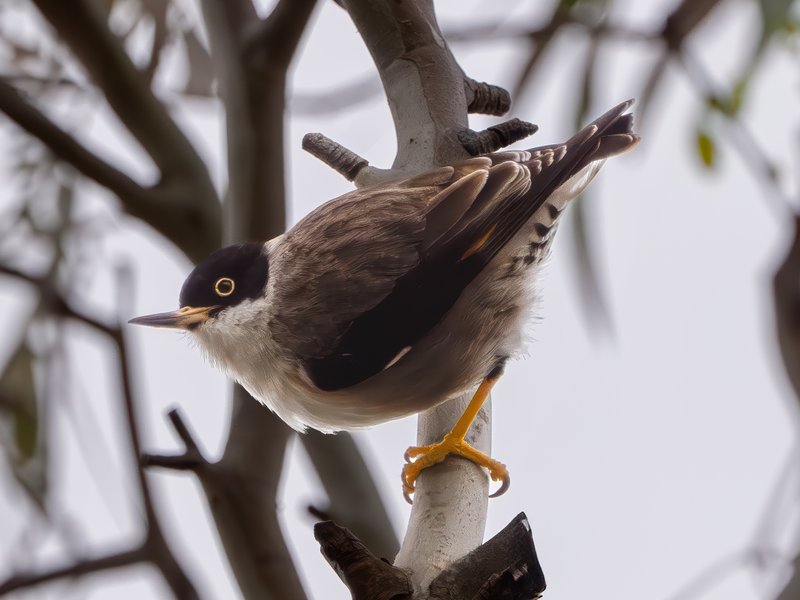
More boldly marked/clean-cut than nominate race. Male: crown black; forehead/sides of face white. Female: crown/forehead/cheeks glossy black. Back plain grey-brown or with slight dark streaks; underparts pure white, unstreaked. Immature: crown greyish black, streaked whitish in juvs. In flight, orange wing band, white rump, white tips to black tail conspicuous.
- Other name
- Barkpecker; Treerunner; 'Woodpecker'.
- Voice
- high-pitched, thin 'seewit-seewee'; 'chip chip'; constant chittering. Alarm-call: rapid, high-pitched 'didididit'.
- Habitat
- open eucalypt woodlands/forests (except heavier rainforests); mallee, inland acacia, coastal tea-tree scrubs; golf courses, shelter belts, orchards, parks, scrubby gardens.
- Breeding
- July-Dec.; March-April.
- Nest
- beautiful, well-camouflaged deep cup of bark flakes, lichens, spiders' web, moulded to resemble bulge in upright fork of eucalypt, she-oak, paperbark, tea-tree; 5-20 m high.
- Eggs
- 2-3; blue-white/grey-white, speckled, blotched glossy black, olive-brown; faint grey markings in zone.
- Range & Status
- c. and e. Vic.; e. NSW-inland s. Q, merging there with race leucocephala. Merges with race pileata in w. Vic.-cw. NSW. Common. Sedentary or nomadic.
- Habitat
- forests/woodlands of Divide/coastal plain; in n. parts, open grassy woodlands.
- Range & Status
- from Clarence R. (ne. NSW), to Darling Downs-Mitchell-Blackall-Suttor Ck (Q), to coast near Mackay. Merges with nominate race in ne. NSW-se. Q, and with striata in zone n. to Townsville-Charters Towers. (Race albata, 'Pied Sittella', 'lost' since collected near Bowen (Q), late in 19th century. Probably an intergrade between leucocephala and striata; had unique combination of creamy white head/white wingpatches.)
- Habitat
- eucalypt forests, grassy woodlands/scrublands.
- Range & Status
- ne. Q; Townsville-C. York, w. to Normanton. Merges with leucocephala in region of Charters Towers-Townsville and with leucoptera in region of lower Flinders R.-Cloncurry.
- Habitat
- grassy woodlands, timber on watercourses, scrubby timber on ranges.
- Range & Status
- from Opalton-Winton-Cloncurry (Q) n. to Gulf lowlands, w. through Top End (NT) to Kimberley (WA), s. to about Tropic in Q and NT, and to about Broome (WA). Merges with striata in region of lower Flinders R.-Cloncurry (nw. Q) and with pileata in s. NT and mid nw. WA.
- Habitat
- coastal eucalypt forests; woodlands to inland woodlands/scrubs-mallee, mulga, cypress pine; timber on watercourses; gullies, gorges of ranges; also golf courses, orchards, parks, gardens.
- Range & Status
- WA s. of Tropic; s. NT; most of SA; w. Vic. (occasional to inland e. Vic.); w. NSW and sw. Q. Merges with nominate race in c. Vic. and c. NSW and with leucoptera in w. Q-s. NT-mid nw. WA.
- Distribution key to races
- 1. Daphoenositta chrysoptera chrysoptera 2. Daphoenositta chrysoptera leucocephala 3. Daphoenositta chrysoptera striata 4. Daphoenositta chrysoptera leucoptera 5. Daphoenositta chrysoptera pileata