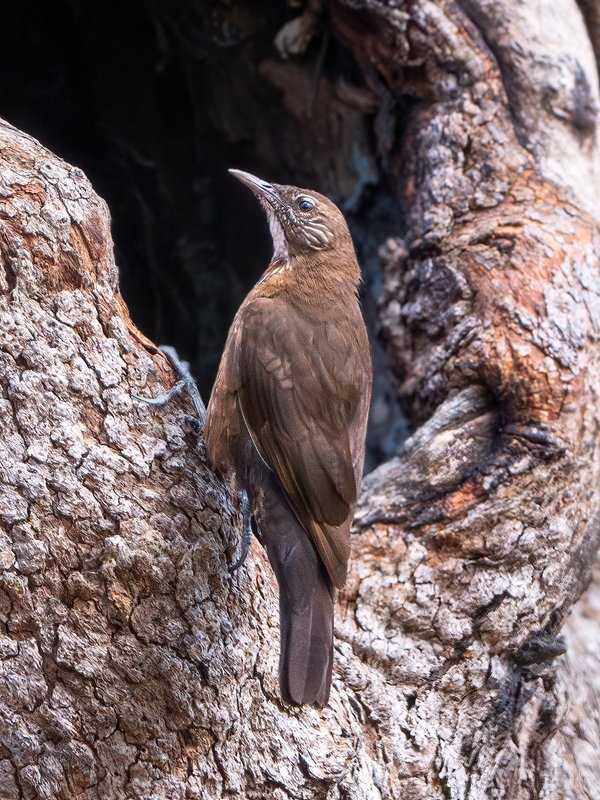
Black-tailed Treecreeper
Climacteris melanurus· 短嘴旋木雀科(1 photos)
Black-tailed Treecreeper
17-20 cm. Largest, darkest treecreeper: sooty-brown to blackish above, underparts to undertail-coverts plain earthy rufous-brown; ear coverts finely streaked black and white; tail black; undertail-coverts dark brown with very indistinct white marks. Male: centre of throat and upperbreast strongly streaked black and white. Female: throat white, streaking into rich chestnut on upperbreast. In flight, shows broad buff-white wing band, visible as a pale streak when wing closed. Pairs, resident groups: feeds much on ground, among fallen branches; eats many ants.
- Similar Species
- Brown Treecreeper race melanotus in region of possible overlap near Leichhardt-Flinders Rs. (nw. Q); lacks throat markings of Black-tailed; has chequered undertail-coverts; in flight away, both look blackish with buff wing band.
- Voice
- clear, strident 'pee, peepeepeepeepeepee, pee, pee'.
- Habitat
- open eucalypt forest, grassy woodlands and open scrub in hilly, breakaway country and lowlands; in nw. Aust., large timber, river red gums on watercourses, dead trees.
- Breeding
- March-May; Sept.-Nov.
- Nest
- of grass; lined with feathers; in hollow 4-10 m high.
- Eggs
- 2-3; pink-white, spotted purple and rich purple-red, mostly at large end.
- Range & Status
- from Carnarvon Ras. (WA), through Hamersley and Kimberley regions into NT, s. to Banka Banka-Alexandria; in nw. Q, e. to lower Leichhardt R.-Cloncurry. Isolated, small, pale race wellsi occurs in Pilbara region of c.-w. WA. Common. Sedentary.
- Distribution key to races
- 1. Climacteris melanurus melanurus 2. Climacteris melanurus wellsi