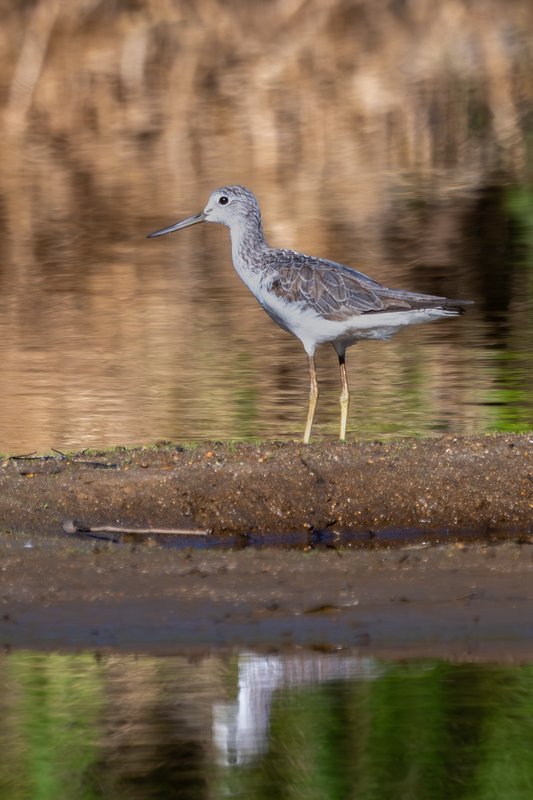
Common Greenshank
Common Greenshank
30-34 cm. Large, pale, nervous wader with medium-long, slightly upturned bill, lead-grey at base, with black tip; grey-green legs. Non-breeding: very pale, with slight dark mark before and behind eye; wings and back pale grey-brown with fine white feather margins and 'toothings'; grey extends to sides of upperbreast; lower breast and underparts white. Breeding Plumage: head, neck and breast more heavily streaked grey-brown; upperparts with scattered, white-notched black feathers. Immature: like breeding, with buffish edges to feathers of upperparts. Singles, small parties, occasional flocks. Nervous: dashes about while feeding; bobs head, flushes with ringing alarm calls alerting other waders. Flight fast with clipped wingbeats: white wedge up back, and white rump, contrast with dark wings, no wingbar; tail white, barred grey-brown; underwing wholly white; toes protrude beyond tail.
- Similar Species
- Marsh Sandpiper: smaller; bill straight, black, needle-like; whiter on face, head and neck; slender yellow-green or grey-green legs protrude further in flight. See also Nordmann's Greenshank, Lesser Yellowlegs.
- Voice
- strident, ringing 'tew-tew', or 'tew-tew-tew' with sobbing intonation, instantly alerting other waders; often at night.
- Habitat
- mudflats, estuaries, saltmarshes, margins of lakes; wetlands, claypans, fresh and saline; commercial saltfields, sewage ponds.
- Range & Status
- breeds from Scotland to s. and ne. Siberia: winters s. Europe, Africa, s. and se. Asia to PNG, Aust. and NZ. Regular, widespread summer migrant to Aust. and Tas. (Sept.-April). Mostly coastal, but inland in suitable habitat. Some overwinter.