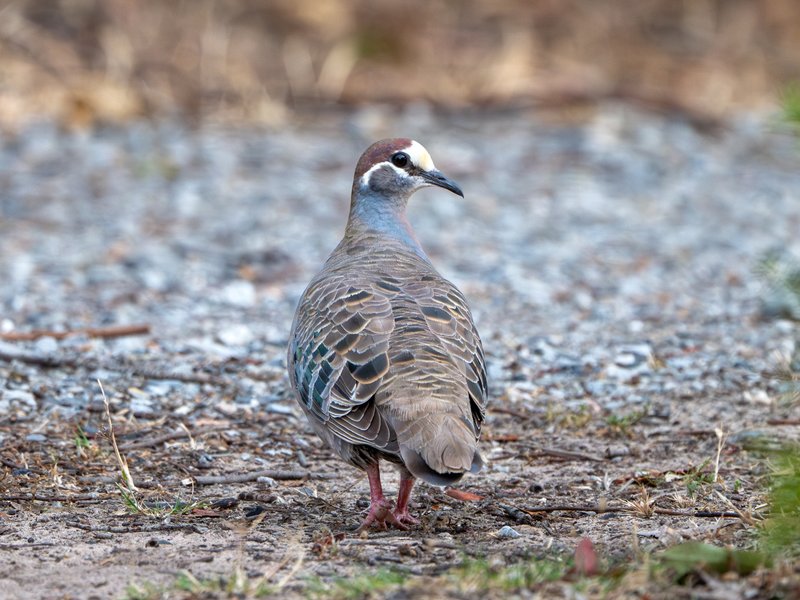
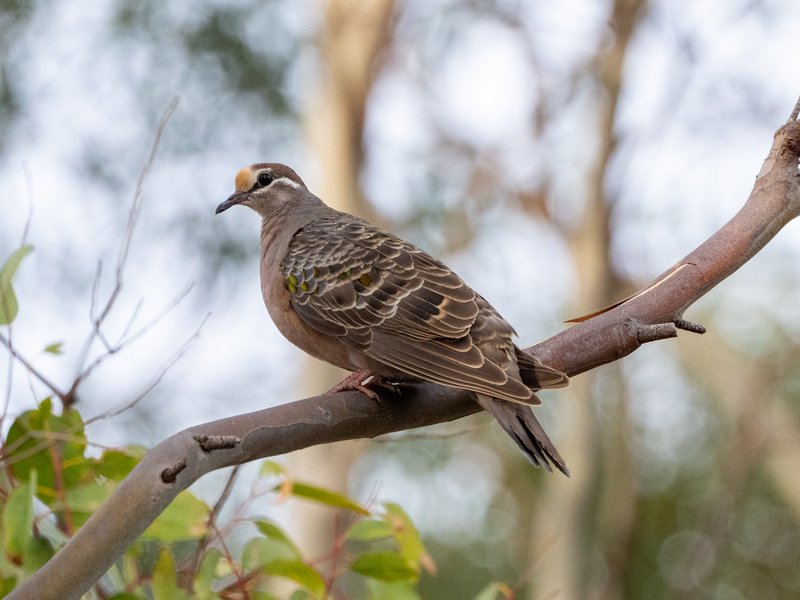
Common Bronzewing
Phaps chalcoptera· 鸠鸽科(2 photos)
Photographed In:
Locations:
Common Bronzewing
32-36 cm. Pale fringes to feathers of upperparts make distinct scaly pattern; note bronzed fiery orange/green patch on wing. Male: forehead yellow-buff; crown purple-brown; white line curves from bill under eye; neck/breast pink-grey. Female: duller; forehead grey, emphasising white line on face; underparts greyer; less bronze on wing. Immature: duller, without bronze. Singles, pairs, open companies: feeds on ground under seeding wattles, grain-stubble at edge of scrub. Wary; departs with clatter or settles, head-bobbing, on limb. Weaves through trees at speed, with wing whistle; showing rich cinnamon wing linings. At dawn/dusk, flies far to drink at creeks, isolated tanks, dams, etc.; comes for grain in farmyards, gardens.
- Similar Species
- Brush Bronzewing: smaller; uniform dark olive-brown above with rich chestnut nape; two blue-green bars cross wings; face/throat pattern differs.
- Voice
- when breeding, monotonous, fugitive but carrying, swelling 'oom', repeated at c. 3-second intervals; lower-pitched, slower than Brush Bronzewing; much slower than Painted Button-quail.
- Habitat
- forests, woodlands, mallee, native cypress scrubs, acacia thickets, coastal tea-tree, banksias and heaths; in summer, alpine woodlands to over 2000 m, coastal and inland.
- Breeding
- mostly July-Jan.
- Nest
- scanty platform or substantial saucer of twigs, rootlets; up to 12 m on horizontal branch, fork, mistletoe clump; near ground on stump; or on old nest of babbler, chough, magpie.
- Eggs
- 2; white, oval.
- Range & Status
- widespread Aust., and Tas. in suitable habitat; stronghold is se. and sw. Aust.; scarce in driest deserts, Nullarbor region (WA) and C. York Pen. (Q). Common; sedentary, locally nomadic.