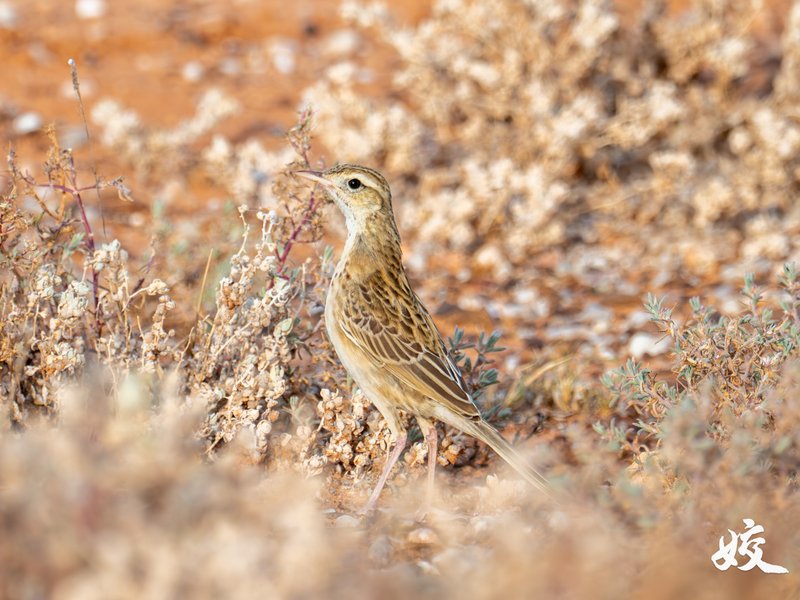
Brown Songlark
Brown Songlark
male 24-26 cm, female 18-19 cm. Male, Breeding: bill black; crown/nape fawn, contrasting with sooty-brown face/throat/breast; legs long, flesh-brown. Male, Non-breeding: bill light brown; lores blackish, eyebrow pale; feathers of upperparts patterned by brown centres, paler margins; rump coloured like back; face/underparts pale grey-brown; throat whitish; centre of breast/abdomen blackish brown. Female: similar, much smaller, paler; bill/lores pale brown. Immature: like female. Mostly silent, solitary, or in loose companies when not breeding; walks, runs through grass. In spring/summer, displaying males sit upright on stumps, fences, telephone poles/wires over grassland, tails cocked. Take off singing, rising on long, circling, line in fluttering flight broken by glides, wings upswept, long undercarriage lowered; descend in shallow glide, drop. Normal flight swift, undulating, with glides.
- Similar Species
- Common Starling, imm. Rufous Songlark: like female Brown; rump rufous. Australasian Pipit.
- Voice
- song of male catchy, metallic, guttural; hence schoolchildren's name 'skit-scot-a-wheeler'.
- Habitat
- pastures, cereal crops; in inland, open grassy country, saltbush etc.
- Breeding
- Sept.-Feb. in s. Aust., after rain in inland.
- Nest
- deep cup of grasses; in shelter of tussock or tuft of grass.
- Eggs
- 3-4; salmon-pink, speckled pinkish red, mostly on large end.
- Range & Status
- mainland Aust., mostly s. of Tropic and inland of Gt Divide: Reaches coasts in ce. Q, w. Vic., SA, incl. Kangaroo I.; most of WA s. of Broome. Summer breeding migrant in s. Aust., arriving from June onwards, departing by March; winters inland. Highly nomadic; moves to coasts during inland drought, may breed. Locally, irregularly common.