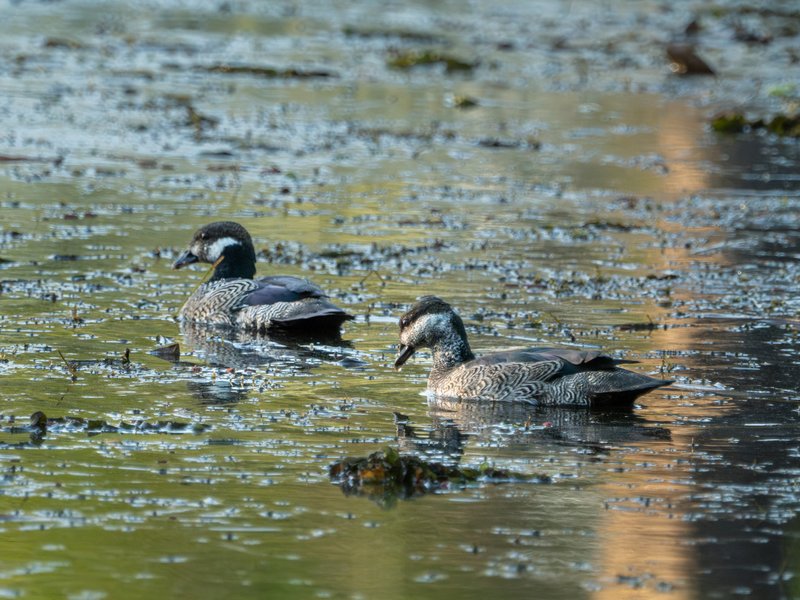
Green Pygmy Goose
Green Pygmy Goose
34-38 cm; span to 60 cm. Male: short, pink-tipped bill; blackish cap; conspicuous white cheeks; glossy dark green neck/upperparts; underparts seem grey-white; white feathers finely barred dark green. Female and immature: duller; faint white eyebrow; cheeks, neck/underparts grey-white. Male, nonbreeding: cheeks smutty, not white. Pairs, small flocks on permanent wetlands among waterlilies, lotus, other vegetation. Seldom ashore; rests on logs, branches. In flight, note flickering white wedge on rear edge of dark wing near body; dark head and neck.
KANGAROO ISLAND Kangaroo Island, Australia's third largest, contains large tracts of native bushland, including mallee which provides habitat for a range of mallee specialists. Around one third of the island is within parks and reserves. It has good populations of species which have declined on mainland South Australia including Eastern Osprey, Bush Stone-curlew, Painted Buttonquail, Hooded Dotterel and Beautiful Firetail. More than 260 species have been recorded here. It is now the only place in South Australia where Glossy Black Cockatoo regularly occurs. The island also supports Rock Parrot, Southern Emu-wren and Shy Heathwren. (Cape Barren Goose has been introduced.) Its coastline borders both the Southern Ocean and Investigator Strait to its north so is an ideal place to see seabirds and shorebirds, many of which are migratory and only present a few months of the year. It is particularly noted for numbers of Red-necked Stint, Ruddy Turnstone and Sharp-tailed Sandpiper. Access to the island is via car ferry from Cape Jervis at the tip of the Fleurieu Peninsula.
Key Australian endemics
Cape Barren Goose, Black-faced Cormorant, Pacific Gull, Purple-crowned Lorikeet, Glossy Black Cockatoo, Hooded Dotterel, Western Whipbird, Purple-gaped Honeyeater, Southern Emu-wren, Shy Heathwren.
Others of regional significance
Antarctic Petrel (rare), Eastern Osprey, White-bellied Sea Eagle, Wedge-tailed Eagle, Bush Stone-curlew, Latham's Snipe, Red-necked Stint, Ruddy Turnstone, Sharp-tailed Sandpiper.
- Similar Species
- see Cotton Pygmy-Goose.
- Voice
- shrill 'pee-whit' uttered in flight; also descending 'pee-yew'; high-pitched 'whit!' and high-pitched musical trill.
- Habitat
- tropical lagoons, lakes, dams with waterlilies, and other semi-emergent water plants. In wet season, shallower swamps of spike-rush, wild rice.
- Breeding
- Dec.-March.
- Nest
- usually in tree hollow in or near water, up to 10 m high.
- Eggs
- 8-12; white or creamy white, lustrous.
- Range & Status
- coastal n. Aust., from Broome (WA) to about Fraser I. (Q). Sedentary or seasonally dispersive, with local dry season congregations on permanent waters. Also Torres Strait islands, s. PNG; some e. Indonesian islands.