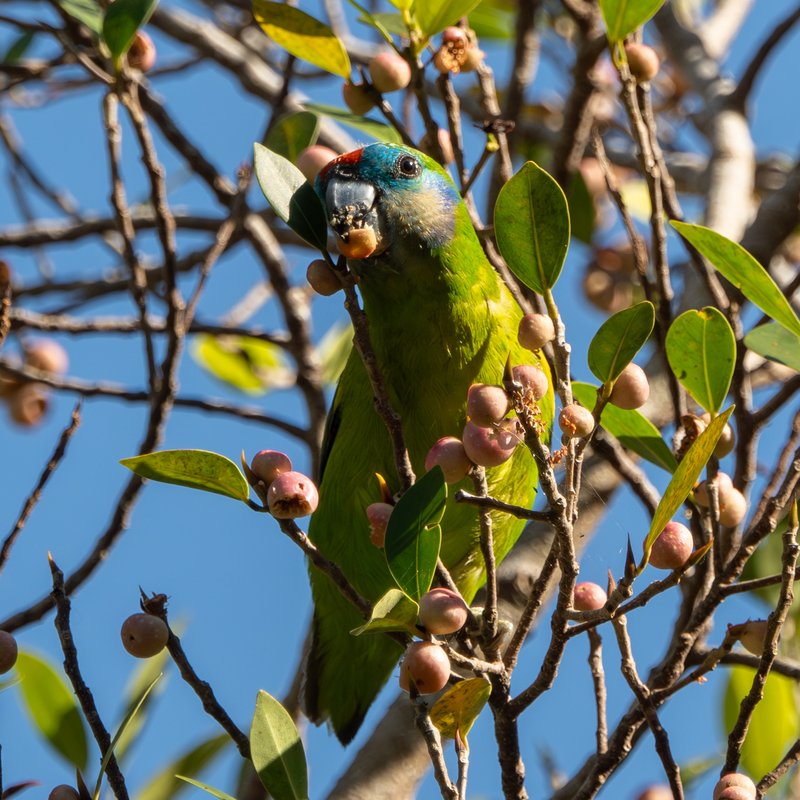
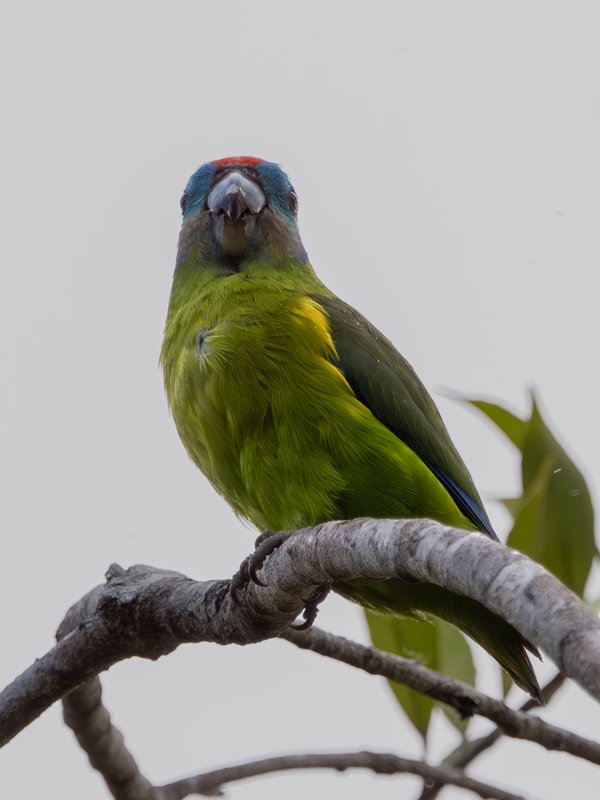
Double-eyed Fig Parrot
Double-eyed Fig Parrot
Cyclopsitta diophthalma includes Coxen's Fig-Parrot Cyclopsitta diophthalma coxeni.
13-16 cm.
Smallest Aust. parrot, with robust, pale grey, blackish-tipped bill, yellow sides of upperbreast, blue outer primaries, a touch of red on secondaries, and very short tail; eye dark brown. The three Aust. races are geographically well separated and can be told apart by head markings:
Race marshalli: 13 cm. Male: red forehead and red cheeks with blue lower edge. Female: no red on head; blue forehead; blue whisker-mark encloses creamish patch on cheek.
Race coxeni: 16 cm. Male: blue on forehead nearly replaces red; red cheek patch smaller. Female: no red on forehead; red cheek patch duller.
Race macleayana: 14 cm. Male: small red patch on forehead separated from red cheek by pale blue between bill and eye; violet-blue whisker-mark borders red cheek. Female: like male, but cheek not red.
Pairs to small flocks; quiet, hard to locate when feeding; they creep through foliage; sometimes revealed by calls and sounds of falling pieces of fruit as they attack native figs to remove seeds; they eat other fruit, berries, fungi, lichens, insect-larvae; and bathe in wet foliage, like lorikeets. Flight swift and darting, over and through canopy; flocks reported to roost communally when not breeding.
Race marshalli: lowland rainforest on ne. C. York Pen. (Q), in vicinity of Lockart and Claudie Rs. and probably beyond.
Race macleayana: highland and lowland rainforests from Cooktown s. to Eungella NP, near Mackay (Q).
Race coxeni: highland, and sparse remnant lowland, rainforests on and e. of Gt. Divide, from c. Rockhampton (Q) to c. Richmond R. (NSW).
Sedentary; locally nomadic. Northern races still moderately common; race coxeni has declined seriously from clearing of lowland rainforest; now critically endangered.
*NB: Anyone sighting a suspected fig-parrot anywhere in the southern part of the species range, that is in highland or lowland rainforest from c. Rockhampton (Q) to Richmond R. (NSW) is urged to advise the nearest office of the National Parks and Wildlife Service immediately. The bird is facing extinction in this region, an active Recovery Team is at work, and every piece of data, even single sightings, can help.
- Similar Species
- Little Lorikeet: bill finer and black; single red patch surrounds bill; no blue in plumage.
- Voice
- quick, penetrating 'zeeet zeeet', longer and sharper than Little Lorikeet, perched and in flight; also chattering twitters.
- Habitat
- rainforests; adjacent eucalypt woodlands and coastal scrubs; timber on watercourses, paperbark woodlands; occasionally visits figs, loquats and other fruit trees in gardens and plantations.
- Breeding
- Aug.-Nov.
- Nest
- on debris in a hole excavated in decayed wood in the trunk or branch of a tree, at heights to c. 10 m, sometimes much higher.
- Eggs
- 2; white, rounded, unglossy.
- Distribution key to races
- 1. Cyclopsitta diophthalma marshalli 2. Cyclopsitta diophthalma macleayana 3. Cyclopsitta diophthalma coxeni