Common Redshank
Tringa totanus· 丘鹬科(2 photos)
Photographed In:
Locations:
Common Redshank
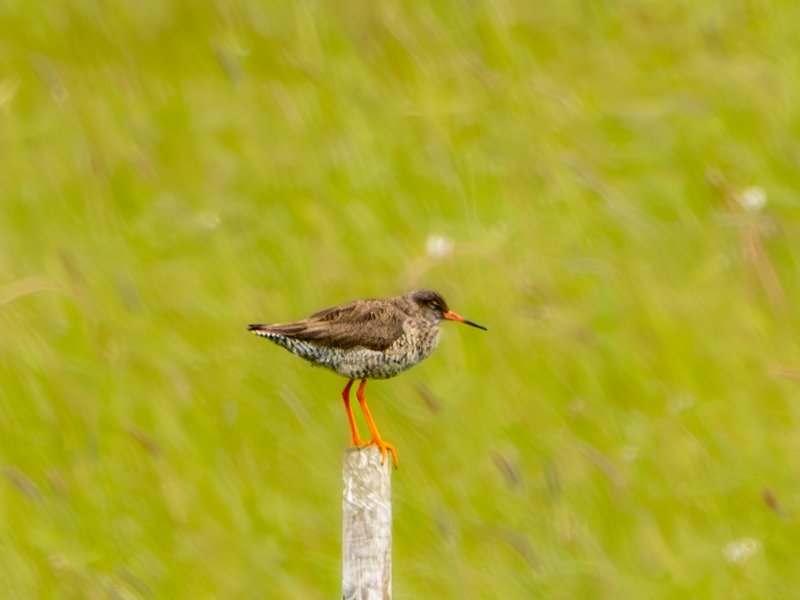
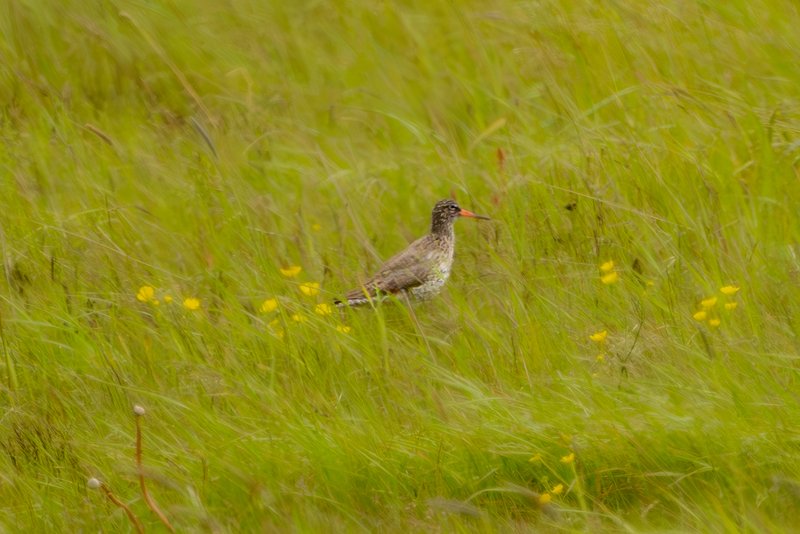
27-29 cm. Like a small, brown-and-white Common Greenshank: bill finer and straighter, orange-red at base, tip black; legs orange-red.
- Breading Plumage
- head and neck heavily streaked black, with short whitish eyeline and eye-ring; upperparts dark grey-brown; underparts white, heavily streaked and barred darker. Non-breeding: eyeline plainer; upperparts grey-brown, mottled darker; underparts paler, more lightly streaked. Immature: feathers of upperparts notched buff; base of bill and legs more orange-yellow. Singles with other waders, or in small flocks in n. Aust. Perches on low objects; nervous - stretches neck, bobs head; noisy. Flight fast and direct, with clipped wingbeats, showing contrasting pattern of blackish upperparts and pointed white rump, flanked by a broad white arc on the trailing edge of each wing. Tail finely barred black and white; red feet extend beyond tail tip. On alighting, holds wings briefly above back.
- Similar Species
- Spotted Redshank: bill finer, slightly turned down at tip, red on lower base only; in flight, no white arcs on wings; secondaries spotted white; legs longer. See Ruff.
- Voice
- musical, down-slurred 'tleu-hu-hu'; alarm call a volley of strident, high-pitched repeated yelping 'teuk' or 'chip' notes.
- Habitat
- tidal sandbars and mudflats; mangroves; freshwater swamps and lagoons; saltfields.
- Range & Status
- breeds from British Isles to e. Asia: migrates to Africa, s. and se. Asia, Indonesian region. Uncommon but perhaps regular, mostly summer migrant to coastal n. Aust.; records Broome (WA), Darwin (NT), Cairns (Q); casual s. Aust. (se. SA; Boort, Vic.). Some overwinter.