Little Egret
Little Egret
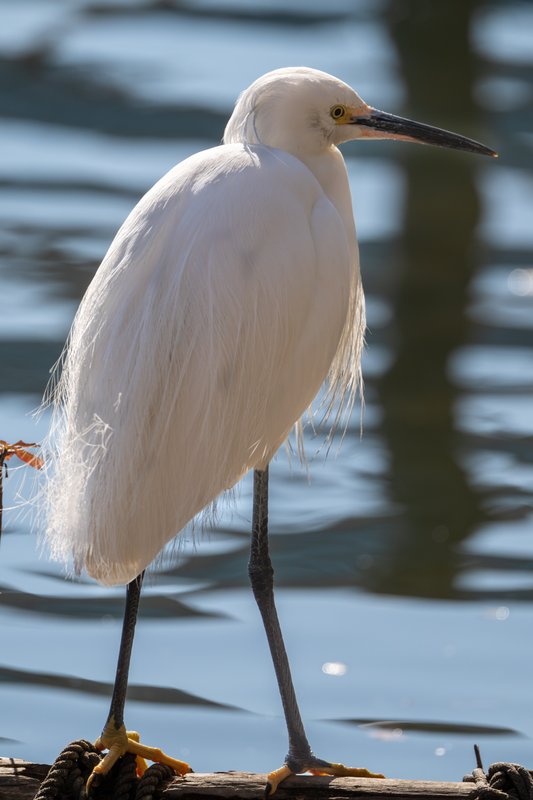
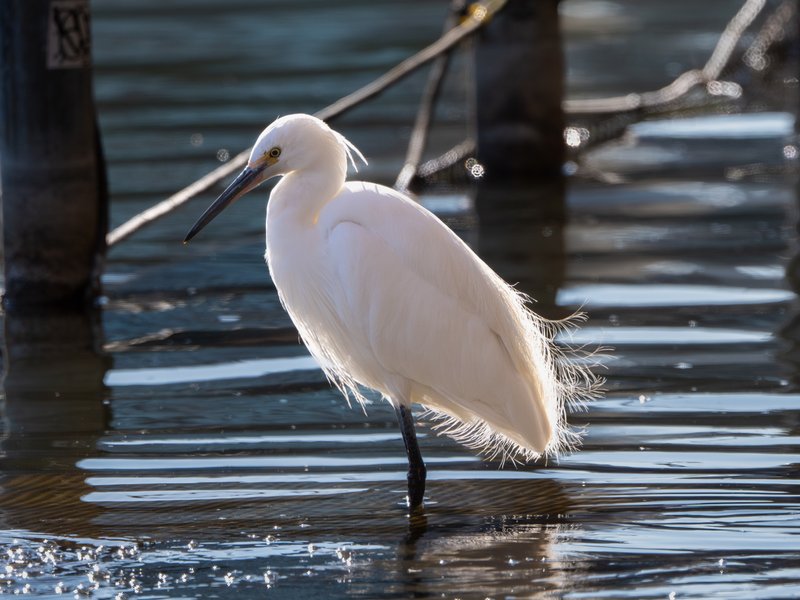
56-65 cm; span c. 90 cm. Fine small egret, about size of White-faced Heron: the slender bill is always black, with part-yellow base to lower mandible and bright yellow facial skin. Legs and feet dark grey, with yellow soles in Aust. race nigripes: a difficult field mark. Nominate race with bright yellow feet and ankles is vagrant to Aust. Non-breeding: filmy plumes reduced, or absent, but some retain head 'ribbons'. Breeding Plumage: facial skin briefly pink or red in courtship; note twin ribbon-like head plumes, and abundant, erectile, filmy plumes on back and breast. Immature: lacks plumes and ribbons; yellow-green facial skin, grey-green legs. Solitary, or loose companies: often feeds near other egrets, spoonbills or ibises, pursuing prey disturbed by them. Feeds actively, stirs with feet; possibly using flash of yellow on soles to disturb prey; with raised wings, dashes after small fish in shallow water.
MACQUARIE ISLAND Macquarie Island is a sub-antarctic island located in the Southern Ocean, approximately half way between Australia and Antarctica. It forms part of the Macquarie Ridge on the boundary between the Indo-Australian Plate and the Pacific Plate. The island is about 35km in length, north to south, and about 5km wide, east to west. A permanent research base is established on a narrow isthmus near the north end of the Island. Politically part of Tasmania, the entire island is a Tasmanian State Reserve, a World Heritage site and, because of its geology, a UNESCO site. It is an important breeding site for seals and seabirds, both hunted during the 19th century. Historically, its wildlife and vegetation have also suffered from the introduction of mammalian pests particularly feral cats, mice rats and rabbits, but these have now been virtually eliminated allowing the vegetation and affected seabird populations to recover. Avian extinctions include the race erythrotis of the Red-crowned Parakeet and the race macquariensis of the Buff-banded Rail. The only successful introduction is also the only resident passerine: the Common Redpoll, self-colonized from the New Zealand introduced population.
Macquarie Island Endemics Royal Penguin and Macquarie Shag.
Non-endemic specialties Breeding species include: King Penguin, Gentoo Penguin, Southern Rockhopper Penguin, Wandering Albatross, Black-browed Albatross, Grey-headed Albatross, Light-mantled Albatross, Southern Giant Petrel, Northern Giant Petrel, Cape Petrel, White-headed Petrel, Soft-plumaged Petrel, Blue Petrel, Antarctic Prion, Fairy Prion, Grey Petrel, Sooty Shearwater, Common Diving Petrel, South Georgia Diving Petrel, Brown Skua, Kelp Gull, Antarctic Tern and perhaps Grey-backed Storm Petrel.
Access to Macquarie Island by other than rangers or researchers resident at the base is normally by ships engaging in expeditions run by commercial operators to the sub-antarctic islands in the summer months, typically November to January. Such tourists ships can only visit the research base and Sandy Bay, several kilometers south of the base, under the supervision of the Tasmanian rangers. This limits the species likely to be seen to those that breed at that time of the year (Grey Petrel is a winter breeder) and in those locations (the Albatrosses nest near the southern end of the island), though some additional species, such as Prions, Petrels and Albatrosses will be encountered in the waters around Macquarie Island. Gentoo Penguin nest near the base and are easy to find, while Southern Rockhopper Penguin have a colony on the nearby rocky headland northeast of the base and are best observed from a zodiac. Sandy Bay has large numbers of Royal Penguin and King Penguin. Northern and Southern Giant Petrel are present both near the base and at Sandy Bay as are Brown Skua and Kelp Gull. Macquarie Shag breed on rocky islets just west of the base and can be seen fishing and collecting nesting material near the beach. The Common Redpoll occurs around the base, but may be difficult to find. Macquarie Island: 54.5S 158.95E. Websites: http://www.parks.tas.gov.au/index.aspx?base=394 and http://www.antarctica.gov.au/living-and-working/stations/macquarie-island .
- Similar Species
- Cattle and Intermediate Egrets; Eastern Reef Egret, white morph: bills seldom black. (See Great Egret, breeding)
- Voice
- a croaking 'kark'.
- Habitat
- tidal mudflats, saltmarshes, mangroves, freshwater wetlands, sewage ponds.
- Breeding
- Oct.-Feb. (se. Aust.); March-April (n. Aust.).
- Nest
- scanty, of sticks; in colony often with other waterbirds, over water; occasionally far from water, in introduced cypress.
- Eggs
- 3-5; pale blue-green.
- Range & Status
- coastal n., e. and se. Aust.; inland and to s. WA when conditions suitable. Common in n., uncommon in s.; winter visitor Tas. Nomadic or migratory. Also Africa and s. Eurasia to PNG. Vagrant NZ.
- Distribution key to races
- 1. Egretta garzetta nigripes