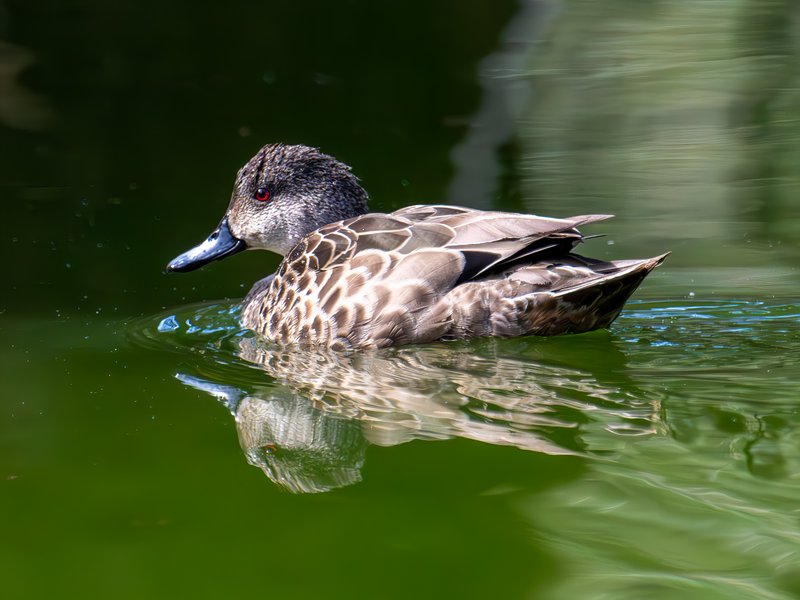
Grey Teal
Grey Teal
40-46 cm; span 60-67 cm. Most widespread Aust. waterfowl: small, mottled grey-brown; easily confused with female Chestnut Teal except for distinctly whitish throat and area around base of bill. In flight, note narrow white wedge on upperwing, edged by dark green speculum; underwing grey-brown, with narrow white wedge up 'armpit'. (Plumage of head, neck and underparts occasionally stained rusty from iron compounds in stagnant water: do not then confuse with male Chestnut Teal, which usually has a blackish or dark green head, and white flank mark.) Pairs, small parties, flocks of thousands in which pairs persist. In se. Aust., flocks often include Chestnut Teal. Dabbles, upends; perches on dead timber over water.
Strzelecki Track The 475 km long track between Lyndhurst and Innamincka traverses the vast, sparsely vegetated gibber plains, wispy grasslands and bushy, usually dry, creeks of the Strzelecki Desert. Two of Australia's rarest birds, Thick-billed Grasswren and Chestnut-breasted Whiteface occur here, and both can be seen within 30 km of Lyndhurst on Mt Lyndhurst Station. There are camping facilities at Mt Lyndhurst Station and permission to enter their land along the track in this area must be requested at the homestead. Birders brave enough to cover the whole track may also be rewarded with such delights as Letter-winged Kite and Grey Falcon. This is fine, if somewhat challenging, birding country as the track is usually well maintained. The best time to go is between May and September. The south end of this track is accessible in a 2WD vehicle from Lyndhurst which is 590 km north of Adelaide. Not long after you leave Lyndhurst, keep an eye out for Inland Dotterel, Gibberbird, White-backed Swallow, Chestnut-breasted Whiteface, Thick-billed Grasswren, Cinnamon Quail-thrush and Chestnut-crowned Babbler. Please remember this is private land and respect the usual restrictions on access. It is usually necessary to travel more than halfway along the main track, at least past Montecollina Bore, to see such birds as Letter-winged Kite; about 5-6 km south of the Strzelecki Crossing has been a fairly reliable site for this rare raptor. Beyond Mt. Lyndhurst Station the track passes through dangerously hot desert country. It is best to not to tackle it during the intense heat of summer (Nov-Mar), and to be fully prepared with equipment, including two spare wheels, vehicle spares and emergency supplies of fuel and water. Just over 40 km north of the Strzelecki Crossing is a track which heads to Cameron Corner on the border with New South Wales. Eyrean Grasswren occurs in the canegrass which grows on the clay-capped sand dunes between Merty Merty Homestead (25 km northeast of Strzelecki Crossing) and Bollard's Lagoon Homestead (15 km west of Cameron Corner), while the valleys between the dunes support Banded Whiteface and Cinnamon Quail-thrush and this is also a good area for Grey Falcon (especially in creekside eucalypts) and the nocturnal dusky hopping-mouse (sand dunes). About 10 mm of rain will make most dirt roads in this area impassable so check the weather forecasts before you head out. As the roads are often narrow and Road Trains can be up to 36 metres long it is wise to pull over and stop if one is approaching. Lyndhurst: 30°17'10"S 138°21'02"E Website: http://www.environment.sa.gov.au
Grey Teal occasionally crossbreed in the wild with Pacific Black Duck and Chestnut Teal. Hybrid progeny with the former are mid-sized between the two species, with larger, blue-grey bills than Grey Teal. They have a suggestion of Black Duck's facial marking, with indistinct pale eyebrow above a long, narrow, dark eyemark, as illustrated. Plumage is paler, more mottled than Black Duck. Hybrids with Chestnut Teal are likely to be difficult to separate with certainty in the field.
- Similar Species
- Chestnut Teal, Pacific Black Duck.
- Voice
- male: high-pitched, clear 'peep!' or grunt-whistle 'gdeeoo'; female: wild laughing chuckle, often at night, and raucous 'quark, quark, quark'.
- Habitat
- almost any water, from coastal inlets, tidal mudflats and mangroves to isolated tanks in mallee scrub or semi-desert; newly flooded depressions, claypans and billabongs, retreating to permanent coastal wetlands in drought.
- Breeding
- mostly July-Dec., in s. Aust.; any month when water conditions are suitable.
- Nest
- of down, mostly in tree hollows.
- Eggs
- 6-9; cream.
- Range & Status
- Aust. and Tas.; strongholds are inland e. and se. Aust. and coastal and sub-inland WA. Widespread dispersal in inland and n. Aust. after good rainfall. Also Indonesia, PNG, New Cal., Lord Howe I., Macquarie I. Self-introduced NZ.