Cape Barren Goose
Cape Barren Goose
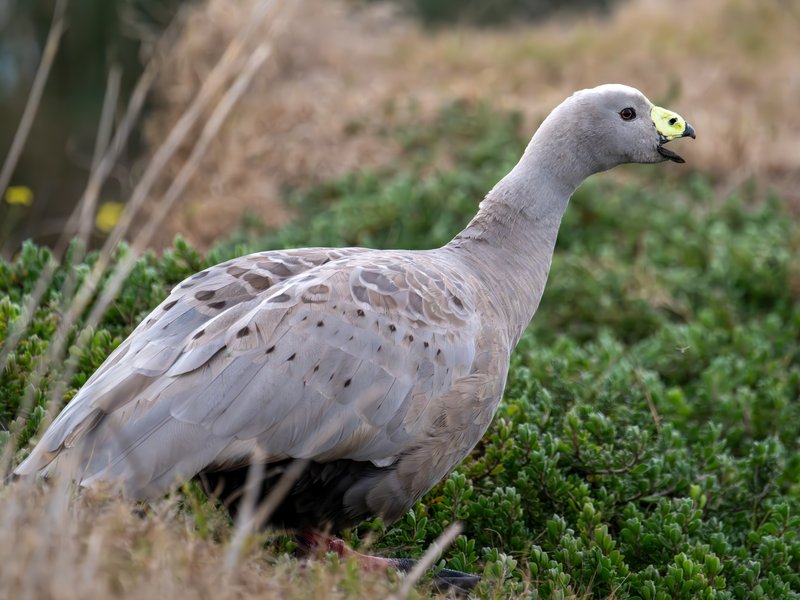
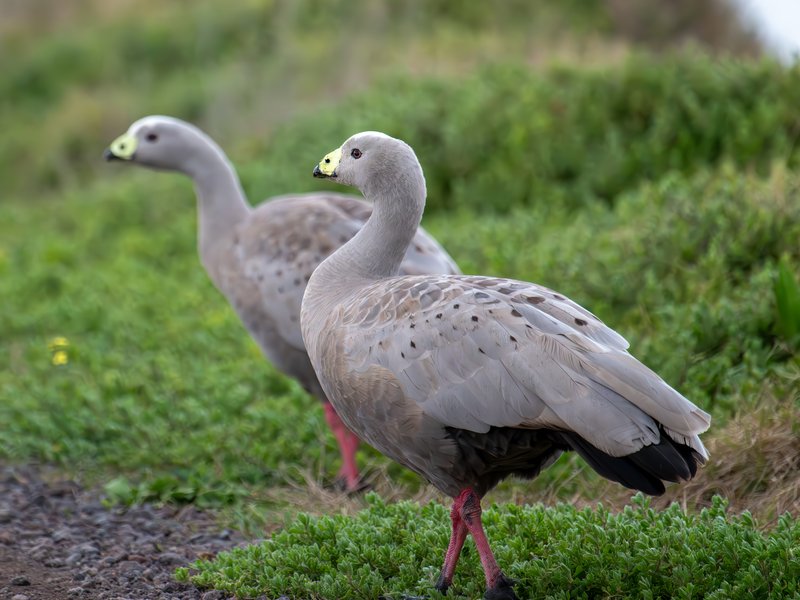
75-90 cm; span 1.4-1.6 m Large pale ash-grey goose with a square black tail, over which grey wing feathers droop in short 'bustle'. Note short black bill, nearly covered by greenish yellow cere; white crown and strong dusky-red legs; feet black. Immature: paler. Breeding pairs (on islands), family groups to summer-autumn flocks of 100+. Grazes open areas, incl. cultivated pastures and slopes of islands among rocks and tussocks; white crown visible when head lowered. Wary; flight powerful, in lines or random mobs, often with a harsh clamour: wingbeats shallow; note pale patch towards dark wingtips, black tail and undertail-coverts. Swims seldom but strongly, stern uptilted.
Rinyirru (Lakefield) National Park Extending south from the edge of Princess Charlotte Bay, this park features extensive river systems, spectacular wetlands, rainforest, and savanna woodlands and grasslands. Golden-shouldered Parrot, Star Finch and Red Goshawk are all found here, as well as Sarus Crane and Australian Bustard. Permanent waterholes, such as Catfish Waterhole on the Kennedy River, are good places to sit and watch birds coming into drink, mostly in the evening or early morning. It is particularly good for birds of prey, waterbirds, honeyeaters, and finches, but with over 200 species there are good opportunities to see most of the local specialties. The park can be access via Laura, about 160 km north west of Cooktown, or Musgrave, 140 km further north along the Peninsula Developmental Road. Golden-shouldered Parrot occurs sparingly in the grassy roadside woodlands dotted with termite mounds near Musgrave, around nearly 300 km north-west of Cooktown, especially around Windmill and Fifteen Mile Creeks, along with Black-backed Butcherbird (which occurs alongside the road from Laura northwards). The best time to look for the parrot is between September and November, at the end of the dry season, when they are most likely to be seen visiting the few remaining areas of water. Dawn at the dam on the east side of the Peninsula Developmental Road, south of Windmill Creek (16 km south of Musgrave), is a good starting point. Otherwise try the roadside between there and Fifteen Mile Creek, 7 km further south. Rinyirru National Park: 15.045833S 144.177778E Website: http://www.derm.qld.gov.au/
- Voice
- both sexes utter pig-like grunts and honks. Male: loud harsh 'ark, ark-ark, ark-ark'. Imm.: reedy whistles.
- Habitat
- offshore islands; improved pastures with clovers; salty ground with native succulents; camps on margins of dams; fresh or brackish swamps and lakes.
- Breeding
- June-Sept.
- Nest
- shallow cup; of grass, twigs, lined with down; on ground beside bush, tussock or rock.
- Eggs
- 3-5; dull white.
- Range & Status
- nominate race breeds from Furneaux Grp. and other islands, Bass Strait (Tas.), to Sir Joseph Banks Grp., Neptune I., other islands in SA; a large, isolated race, grisea, breeds Recherche Arch. and islands w. to near Albany (WA). This race is classified as vulnerable. Some birds wander to adjacent mainland areas, e.g. near Esperance. The nominate race disperses in spring-summer to cultivated pastures on larger islands and nearby mainland areas in n. Tas.; s. and sw. Vic.; se. SA; and Eyre Pen; casual s. NSW. Locally migratory and dispersive. Introduced Kangaroo I. (SA), ACT and elsewhere, incl. NZ.
- Distribution key to races
- 1. Cereopsis novaehollandiae novaehollandiae 2. Cereopsis novaehollandiae grisea