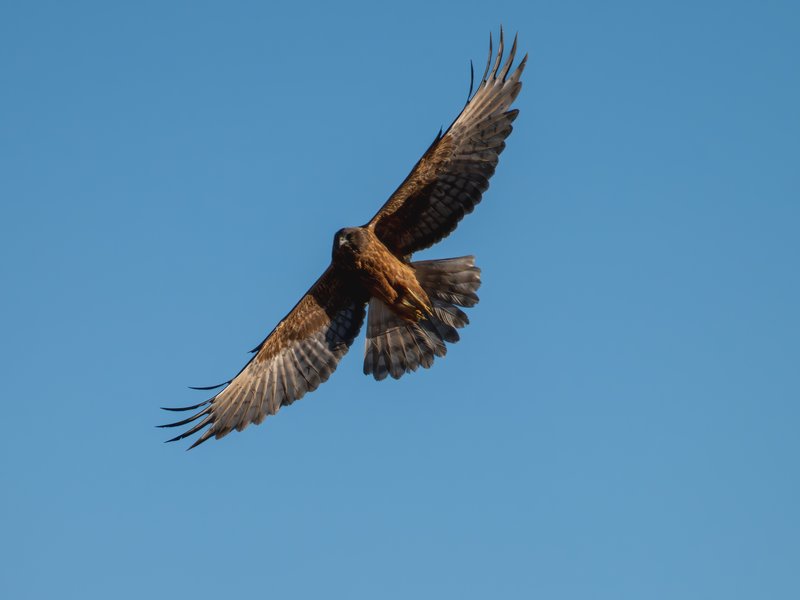
Swamp Harrier
Swamp Harrier
50-61 cm; span to 1.45 m. Female larger. Large, small-headed, long-legged brown hawk with a distinct facial disc, buff-streaked breast and white rump. Sits tall and slim on fence-posts, ground, swamp vegetation. Sails low over crops, etc., on upswept long wings, head downpointed, rocking a little; white rump readily visible. Both sexes become greyer with age; old males have ash-grey inner primaries and unbarred ash-grey tail; breast buff to whitish with buff streaks; underwing whitish; wingtips grey, barred black. Some pale males have slate-grey hood. Female: browner; underparts more rufous; wings broader, curved trailing edge has broader black margin (Marchant & Higgins, 1993); shadowy bars on grey wingtips and tail. Juvenile: chocolate-brown with rufous tones; cream streaks on nape sometimes form a large, pale mark; small, pale rufous rump; underwing blackish with rufous tones; large whitish patch at base of primaries; tail has shadowy bars. Singles, pairs, family parties: over territory in spring, males soar high, calling and cutting spectacular loops and circles with wings in a stiff V.
- Other name
- Marsh Harrier; Swamp Hawk.
- Similar Species
- Spotted Harrier.
- Voice
- short, high 'kyeow!'; thin repetitive calls.
- Habitat
- swamps and wetlands, tall grasslands, grain crops, coasts, islands, heathlands, saltmarsh, bracken, bore drains.
- Breeding
- Sept.-Feb.
- Nest
- low heap of grasses, sticks, rushes; in tall grass, grain crop; cumbungi, other dense, low vegetation on ground or over water.
- Eggs
- 3-5; blue-white, rounded.
- Range & Status
- breeds mostly Tas., Vic., s. SA and far s. WA. Migrates n. from Tas. and s. coastal districts in autumn, or makes local winter movements. Winter visitor to inland and coastal n. Aust., possibly to PNG, e. Indonesia. Also Norfolk, Lord Howe Is.; NZ and sub-Antarctic islands; Macquarie I.; Cocos-Keeling Is. (Indian Ocean); Pacific islands.